

Bring Winter Color to Your Garden with Hellebores
Transform your winter landscape with these exquisite perennials

Jessamyn Tuttle
By Jessamyn Tuttle, Skagit County WSU Extension Master Gardener
Even though we’re lucky enough to have mild, mostly green winters here in the Pacific Northwest, we’re already starting to get a little starved for flowers by January. If you’d love to see some color in your winter garden other than green and brown, consider planting some hellebores, a perfect way to get your flower fix. A well-behaved perennial that comes in a range of colors, hellebores can start blooming as early as December and continue the show through March.
There are about 15 species of hellebore, none of which are native to the United States. The most common garden species are Helleborus niger and Helleborus orientalis. H. niger is commonly called Christmas rose, because it starts blooming as early as December. A very sturdy plant with waxy leaves, it tends to be just under a foot tall, with masses of single white flowers with yellow stamens. H. orientalis, called Lenten rose, blooms later, usually late January through mid-March, and tends to be taller, from 1 to 1.5 feet high, with downward-facing blooms. Both species are hardy in zones 4-9 and prefer shade.
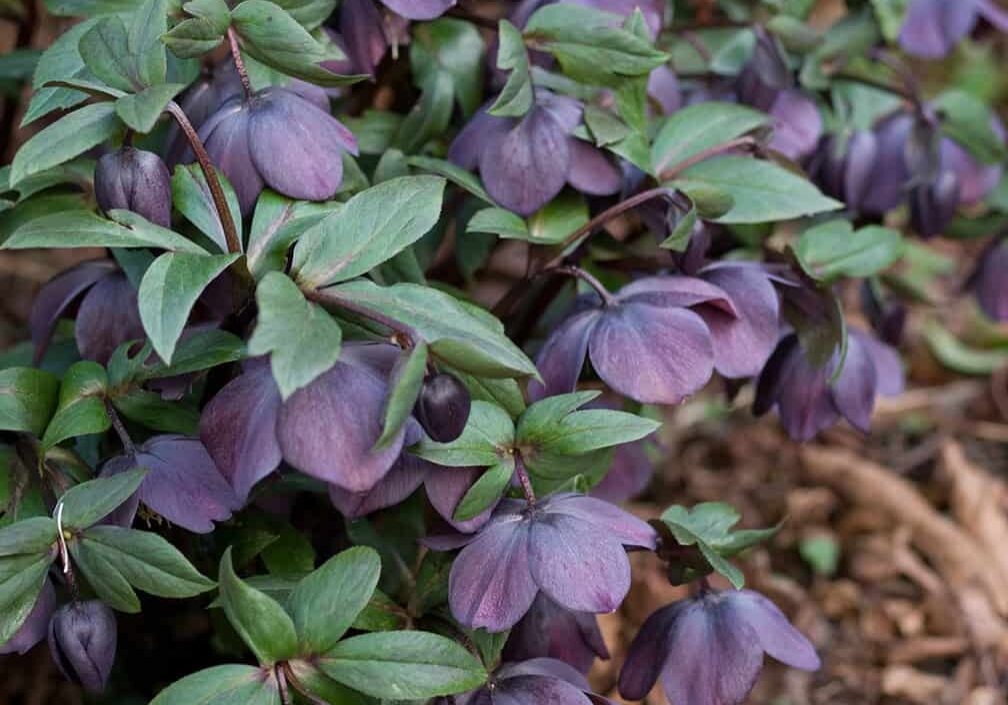
Hybridizers have developed hellebore cultivars with deep-purple, almost black flowers like this H. orientalis in author's garden. Photo © Jessamyn Tuttle

H. foetidus is a showy plant with deeply dissected leaves and small pink and green bell-like flowers on stems. Photo © Jessamyn Tuttle
A bit less commonly grown is H. argutifolius, also called Corsican hellebore or holly-leaved hellebore, which is the largest of the hellebores at 3’ tall and up to 5’ wide, with showy stalks of white flowers. It’s happy in part shade to full sun, requires good drainage, and is fully drought-tolerant once established. A caulescent (stemmed) species, the flowers form at the end of the leaves instead of coming up directly from the base, and when bloom is over, the entire leaf stem can be cut. This category also includes H. foetidus, or stinking hellebore (not as smelly as the name would suggest), a showy plant with deeply dissected leaves and small pink and green bell-like flowers.
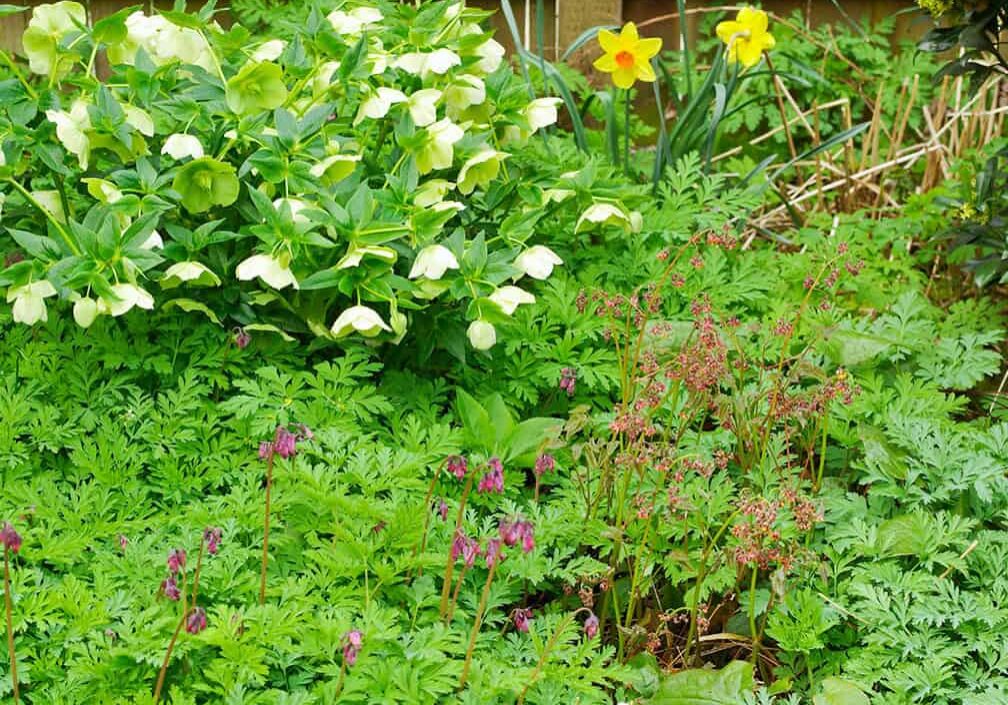
Helleborus orientalis with Epidmedium and native bleeding heart in author's garden. Photo © Jessamyn Tuttle

Helleborus orientalis with primroses and bleeding heart in author's garden. Photo © Jessamyn Tuttle
Most hellebore flowers tend to come in pink and purple tones, but include pure white, green, purple so dark it’s nearly black, and even yellow. Many have freckles or smudges, and there are double-flowered varieties for extra showiness. Hellebores had a resurgence of popularity in the 1990s. Since then, there have been considerable improvements in the quality and variety of plants, with new cultivars and strains coming out every year. One of the best is a hybrid strain called Winter Jewels®, developed by Northwest Garden Nursery in Oregon. These hellebores have fine foliage and elaborate flowers, like ‘Cotton Candy’, a double baby pink with dark pink freckles, and ‘Cherry Blossom', a strawberry-streaked flower with a ruffled center like an Elizabethan collar. There’s also a yellow with raspberry veining and speckles called ‘Golden Sunrise'.
Other popular hybrids include ‘Ivory Prince’, a very tough, early-blooming plant with dark burgundy-pink buds that open to upward-facing, creamy white flowers, and ‘Monte Cristo', with white/peach/pink flowers contrasting with blue/gray foliage. Another stunning variety is ‘Anna’s Red’, from the Frostkiss® series, with rich pink flowers that darken to burgundy and dark leaves marbled with cream.
Hellebores do best in bright shade and can tolerate a range of soils. Like all plants, they should be well watered for their first summer in the ground, but then are moderately drought-tolerant, although most varieties appreciate regular summer water.
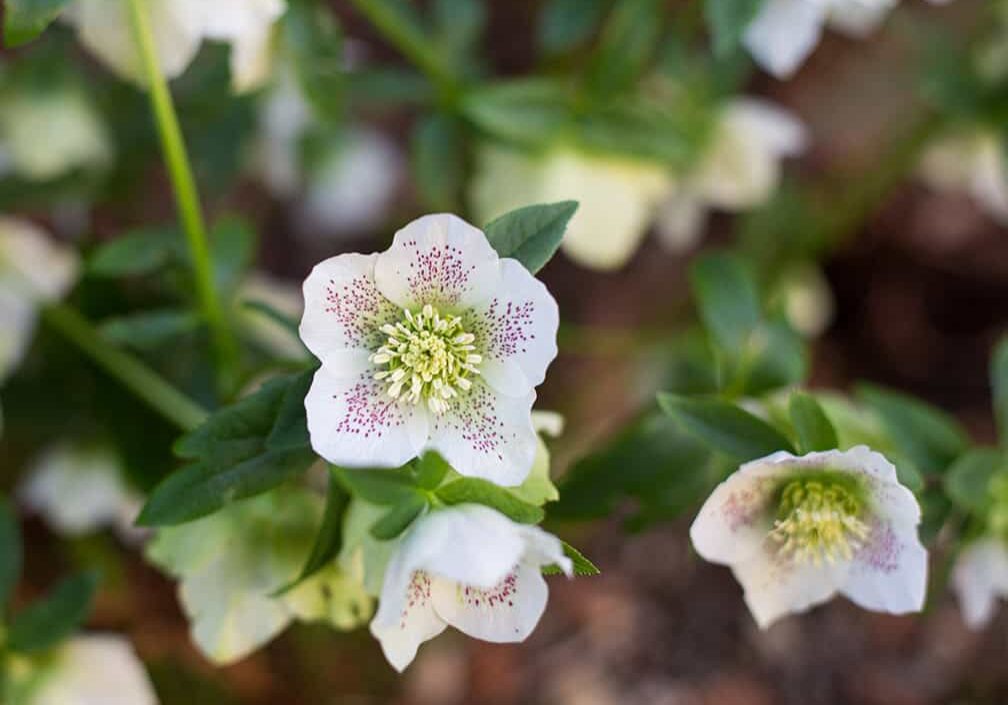
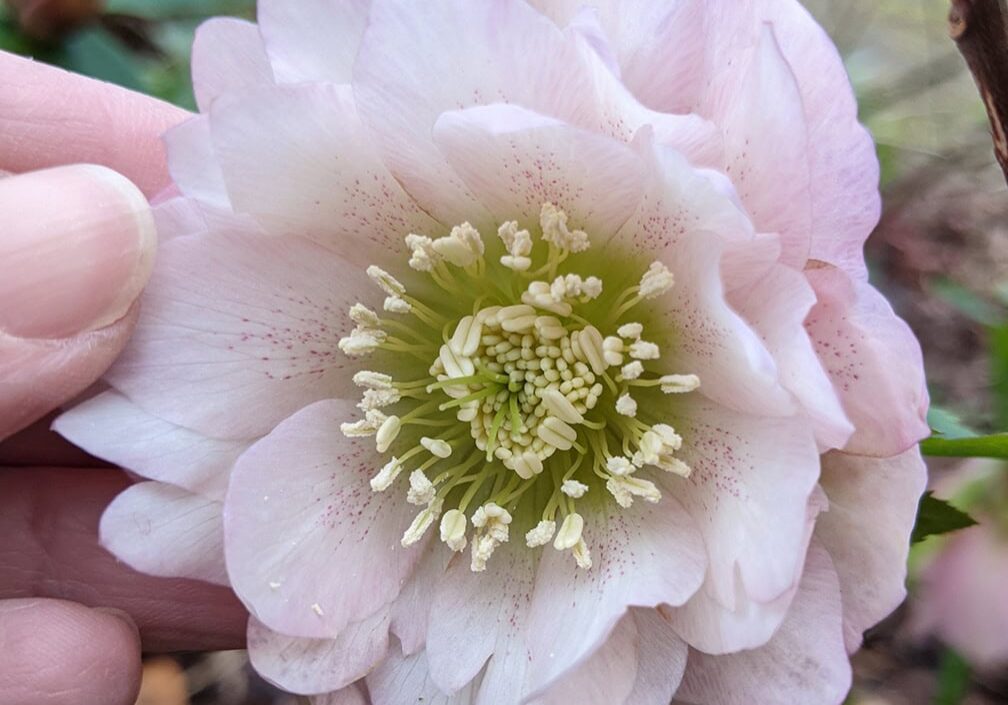
Helleborus x hybridus 'Windcliff Double Strain'
Photo © Jessamyn Tuttle
Plants grow in gradually expanding clumps and can reseed but are generally not invasive. The flowers remain decorative for some time after full bloom but can be cut off to prevent reseeding and encourage foliage growth. Like a sword fern, new growth comes out of the center of the clump as the previous season’s leaves fall to the ground. Since hellebores are very susceptible to botrytis, a fungal disease, and to keep things tidy, cut off old leaves as the new flowers rise in the winter or early spring. Plants can be divided to propagate them, but they prefer being left alone and will often take an extra year to bloom again if disturbed.
When planting new hellebores, make sure to put them where you can see them bloom in winter. Plant in combination with spring bulbs, especially early daffodils and crocus, and other winter-blooming plants like cyclamen and witch hazel for a fabulous winter garden, or mix with other tough shade plants like sword fern and Epimedium for year-round interest in a dark corner. They make a beautiful groundcover under deciduous trees, where the flowers can shine before the trees leaf out, providing them with summer shade. They can even do well in containers as long as you don’t mind the lack of summer flowers.

Hellebores at Washington Park Arboretum, Seattle, WA Photo © Jessamyn Tuttle
All hellebores, like many other plants in the Ranunculaceae family, are toxic to people and animals if ingested. However, this is rarely a problem because the leaves are tough and a bit prickly. Still, it also means that deer very seldom interfere with them. In addition to being deer-proof, hellebores seldom have trouble with insect or slug damage. Although aphids can occasionally crop up, they can be washed off with a blast of water from a hose and seldom do lasting damage.
Because many hellebores start putting up flower stalks in January, there’s always a risk that they’ll get snowed on or frozen. While this won’t hurt the plant, it can sometimes result in damaged stems. Usually, they’ll just pop right back up after the snow melts, but if stems are broken, cut the flowers and bring them inside to float in a shallow bowl of water for a beautiful table display. Bringing them in as cut flowers also lets you admire them up close without getting down on hands and knees in the muddy yard.
If you’re just starting to be interested in hellebores, take advantage of local nurseries holding special hellebore days, or visit garden shows and public gardens to see huge swaths of hellebores in full bloom in February and March, then take that inspiration back to your own garden to make next winter spectacular.


Resources:
Hellebores: Winter Jewels. Portland Nursery Blog, Portland, Oregon
Our Hellebores. Northwest Garden Nursery
Bunting, A. (2025) Hellebores: Care, Varieties, and Tips for Your Garden. The Pennsylvania Horiticultural Society
Poisonous to Livestock: Helleborus niger – Christmas Rose. Cornell University, Ithaca, NY
Plant Finder: Helleborus orientalis. Missouri Botanical Gardens, St. Louis, MO
Great Plant Pics: Corsican Hellebore. Elisabeth Carey Miller Garden.
Caulescent Hellebores… A Hint of Silver, a Touch of Platinum. Pacific Horticulture.
ABOUT THE AUTHOR:
Jessamyn Tuttle is a Skagit County WSU Extension Master Gardener, Class of 2017. She is co-manager of the Perennial Plant House in the Discovery Garden on Hwy 536 west of Mount Vernon.
Questions about home gardening or becoming a master gardener may be directed to Skagit County WSU Extension Office, 11768 Westar Lane, Suite A, Burlington, WA 98233; by phone: 360-428-4270; or via the Skagit County WSU Extension website.
Washington State University Extension helps people develop leadership skills and use research-based knowledge to improve economic status and quality of life. Cooperating agencies: Washington State University, US Department of Agriculture, and Skagit County. Extension programs and policies are available to all without discrimination. To request disability accommodations contact us at least ten days in advance.
Thanks for the reminder Jessamyn. I’d better go look at my hellebore (single). I need more!
Excellent article and images – thank you.
Thanks Jessamyn. I love your H. foetidus! I am very happy with the beauty and low maintenance of my hellebores. I think of them as self-weeding because when the leaves die back, they make a mat that thwarts weeds. They are about as perfect of a plant as you can choose for your garden.