

Conifers in the Homescape
Selecting and caring for conifers will provide year-round beauty and function
By Alison Hitchcock, Skagit County WSU Extension Master Gardener

Alison Hitchcock
Conifers make a valuable addition to any garden, providing a variety of landscape uses: hedging, windbreaks, ground covers, or specimen focal points. They provide year-round color, texture, and a range of appealing attributes. Once established, conifers require very little care, rarely need fertilizer, resist most insects and diseases, and pruning becomes an optional task.
The term conifer is derived from the Latin words "con" and "ferre, referring to the cone, and the term "to bear". Broadleaved trees such as holly, laurel, or eucalyptus reproduce with flowers and fruits; conifers reproduce through cones. Both pollen (male) and seed (female) cones are formed; all are wind-fertilized. Most conifers are monecious (Greek, one house) with male and female cones occurring on the same tree, but several genera are diecious (two houses). The age at which a conifer bears cones varies, but it usually takes at least 10 years before cones appear. Maturation can vary from 1 to 3 years. Some dwarf varieties never develop cones.
Know & Grow Series:
Conifers in the Home Landscape
Free, no registration required
Listen to Master Gardener Alison Hitchcock speak on caring for conifers in the home garden. Alison Hitchcock has been a Skagit County WSU Extension Master Gardener since 2001. Prior to retirement, she worked for the Department of Natural Resources as the Northwest Regional Silviculturist.
Tuesday, October 21, 2025 - 1 pm - 2:30 pm
NWREC Sakuma Auditorium, 16650 State Highway 536, Mount Vernon

While the majority of conifers are considered evergreen (foliage retained more than one growing season), there is a small group of conifers: larch, bald cypress, and dawn redwood that lose their needles every year, i.e., deciduous. Despite the term, conifers do not keep all their leaves indefinitely. Needles become less efficient as they age, accumulate surface debris, and receive lower levels of sunlight due to interior foliage. These unproductive leaves are shed over time, though the needle life span will vary by species. Pines rapidly shed needles every 3-4 years; spruce and fir needles turn yellow and drop gradually; yews turn yellow and drop in the late spring or early summer of their third year. Sequoias, redwoods, and arborvitae shed small branchlets. We witness the flagging of western red cedar each autumn as older foliage dies.
Tree and Site Selection
When selecting a conifer, there are several things to consider: function, size and space needs, sunlight, and soil needs. Numerous cultivars of all shapes and sizes are available from local nurseries and garden centers to meet the needs of your garden design.

Selected Conifer Names |
||
| Family | Genus | Common Name |
| Cupressaceae | Thuja | red cedar (arborvitae) |
| Cupressaceae | Cupressus | cypress |
| Cupressaceae | Chamaecyparis | false-cypress |
| Cupressaceae | Colocedrus | incense-cedar |
| Cupressaceae | Juniperus | juniper |
| Cupressaceae | Sequoia | coast redwood |
| Cupressaceae | Sequoiadendron | giant sequoia |
| Cupressaceae | Metasequoia | dawn redwood |
| Cupressaceae | Cryptomeria | Japanese cedar |
| Cupressaceae | Taxodium | bald cypress |
| Taxaceae | Taxus | yew |
| Taxaceae | Cephalotaxus | plum yew |
| Pinaceae | Thuja | red cedar (arborvitae) |
| Pinaceae | Larix | larch |
| Pinaceae | Cedrus | true cedar |
| Pinaceae | Pinus | pine |
| Pinaceae | Tsuga | hemlock |
| Pinaceae | Pseudotsuga | Douglas fir |
| Pinaceae | Ablies | true fir |
| Pinaceae | Picea | spruce |
| Scadopitaceae | Sciadopitys | umbrella pine |
| Araucariaceae | Aracucaria | monkey puzzle |
| Araucariaceae | Wollemia | Wollemi |
| Podocarpaceae | Podocarpus | podocarp yew |
A cultivar represents a deviation from normal characteristics common to a species. Though some cultivars are the result of human hybridization, most cultivars arise from mutations that give rise to dwarf and giant forms, variegated foliage, weeping, and prostate habits. If the unique traits are maintained over multiple generations, plant biologists can give a cultivar a new name and propagate it through grafts and cuttings.
When selecting a conifer, one must anticipate the tree's mature size and space needs. The American Conifer Society has established four size categories for conifers: Miniature, Dwarf, Intermediate, and Large, to aid in landscape design. Once established, growth may vary slightly due to local environmental conditions, but registered cultivars should maintain their described size. It is essential to note that any conifer will continue to increase in size at the stated rate beyond 10 years. If your tree becomes too large, corrective measures are limited to perpetual pruning, relocation, or removal. In most cases, severe pruning will destroy the conifer's natural charm, although some plants may recover over time. Often, removing and replacing a large tree is easier, although removal can be costly.

| Shade Tolerance of Selected Conifers |
Tolerant
Intermediate
|
Intolerant
Very Intolerant
|
Shade and soil conditions can be particularly important when selecting the right conifer. Shade-tolerant species are able to thrive and reproduce under low light levels, while intolerant species require full sunlight and little or no competition. Most conifers prefer full sun and evenly moist, well-drained, neutral to acid soil. The few species that tolerate wet soils include Atlantic white cedar, dawn redwood, and some spruces. Drought-tolerant species include juniper, cypress, and pine.
Pruning and Shearing
The pruning needs of conifers are minimal if plants are chosen to fit their allotted space. Always prune a conifer for a particular purpose: removal of diseased or dead wood, control of size, and control of shape. Though the techniques sound similar, there are essential differences between pruning and shearing. Pruning refers to the selective removal of branches for the health and proper size of a plant. Shearing removes foliage to create a uniform surface or shape without regard to branch structure. Pruning cuts encourage growth throughout the plant, while shearing is generally limited to the current year's growth.

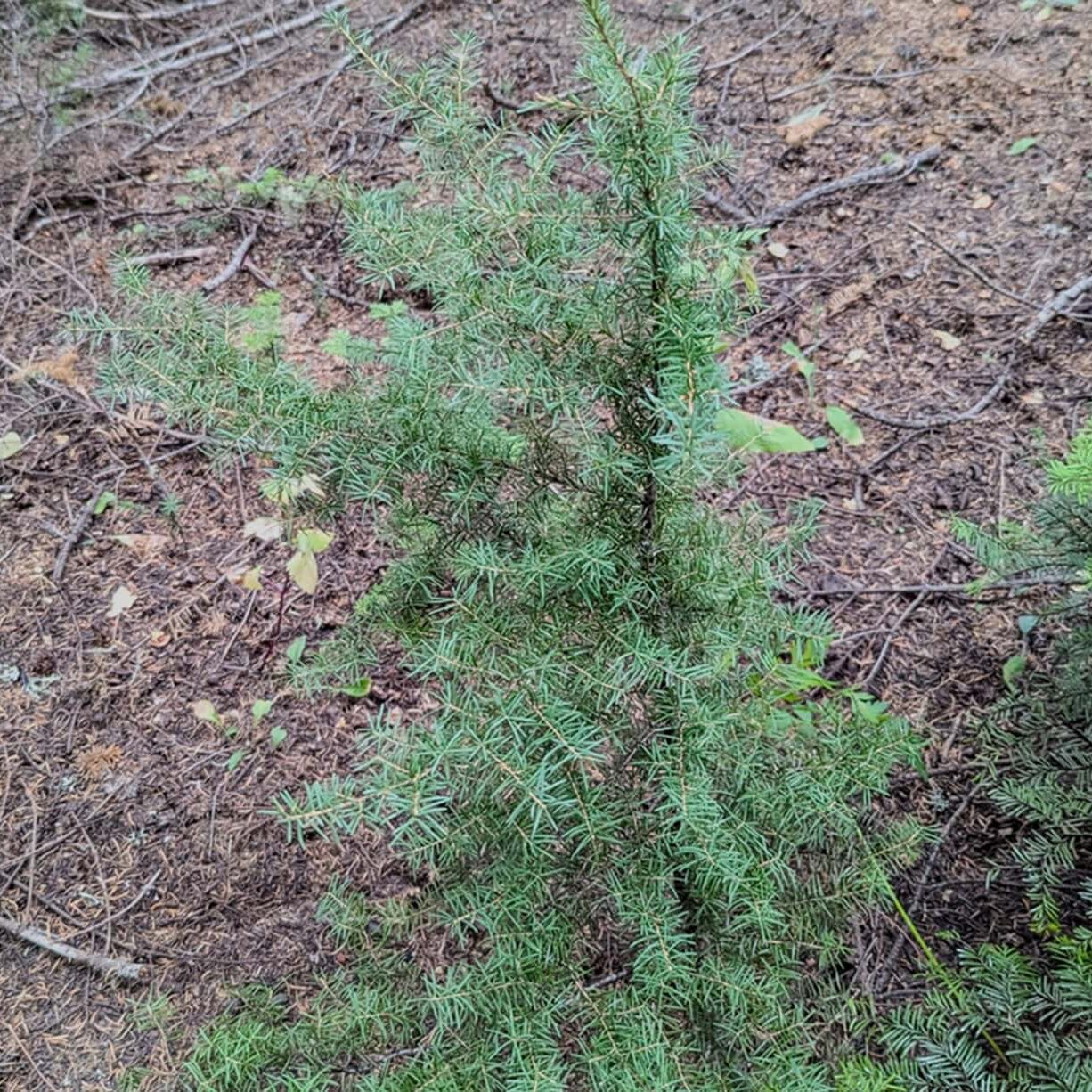

Pruning of Douglas fir leader. Developing Quality Christmas Trees in the Pacific Northwest © Oregon State University Extension | Chad Landgren
Pruning Whorl-branched Conifers
(Douglas fir, spruce, true fir, true cedar, pine)
Whorl-branched trees will not form new buds on old wood, so do not cut back to the brown, aged stems. To control height or branch length, always cut back to a side branch or dormant bud. Pruning the outermost branch tips back to a bud will also encourage fullness. For a formal shape, shear in summer after new growth has expanded but before new buds form in the fall. To replace a lost leader, support the uppermost lateral branch to a vertical position with a splint and remove after one growing season.
Unlike other whorl-branched conifers, a pine's current year's shoots (candles) should be pruned in late spring. To slow growth or produce a more compact shape, pinch one-third to one-half of each candle; to maintain size, remove most of each candle. Shearing is not recommended for pines.
Pruning Random-Branched Conifers
(Juniper, Arborvitae, Chamaecyparis, yew, hemlock)
Pruning to maintain shape is best done in early spring so that new growth covers the cut ends. Snip branch tips back lightly. Hand pruning rather than shearing creates a more natural shape, but plants can be sheared in early summer once the tree stops growing.

Sheered topiary Photo David McElwee | Pexels.com
Yew and hemlock are exceptions to most conifers in that new growth will develop on old wood, and they are forgiving of poor pruning and very suitable for hedging. To maintain size, prune in late winter or early spring before new growth begins. Avoid trimming the tops of hedges until the desired height has been reached. If shaping for fullness or a formal hedge, lightly trim back the outermost new growth using hand pruners or hedge shears. Shearing of new growth can continue into early summer.
Incorporating conifers into your garden design not only enhances visual interest but also promotes a resilient landscape with minimal upkeep. By carefully considering their size, light, and soil requirements these remarkable plants can thrive in your garden. Whether used as hedges, focal points, or ground covers, conifers will provide lasting beauty and functionality to your outdoor space.
When to prune or shear is mainly dependent on conifer branching patterns, either whorl-branched or random-branched. Whorl-branched (determinate) conifers put on one flush of growth each spring. Buds at the tips of the tree flush in the spring, elongate until sometime in July, and then set new buds in the fall for the following spring. Random-branched (indeterminate) conifers produce new growth from buds at the tips of the branches and from dormant buds further back on the stem than the whorled-branched species. The result is that random-branched conifers can be cut back more severely and still produce new growth.
General guidelines for pruning:
- Remove dead, diseased, or broken branches anytime.
- Prune all conifers, except pine, before new growth starts in the spring or during the semi-dormant period in mid-summer after growth has stopped.
- If shearing, begin in late spring or early summer after new growth begins.
- Do not prune evergreens in late summer or early fall; new growth will not harden off and will be subject to winter injury.
- Do not prune into the inactive center because new branches will not form to conceal the stubs.
- For prostrate or open-grown trees, selectively prune individual branches rather than shearing the whole plant.
Resources and References:
American Conifer Society, accessed April 25, 2025,
Welch, H., (1966) Dwarf Conifers - A Complete Guide. Charles T. Branford Company, Newton, Massachusetts
Landgren, C. (2025) Developing Quality Christmas Trees in the Pacific Northwest, Oregon State University Extension.
Bird, R. (1994) Ornamental Conifers. Quintet Publishing Limited, London, UK.
Hartman, J., Pirone, T., and Sall, M. (2000) Pirone’s Tree Maintenance. 2000. Oxford University Press, New York, NY.
ABOUT THE AUTHOR:
Alison Hitchcock has been a Skagit County WSU Extension Master Gardener since 2001. Prior to retirement, Alison worked for the Department of Natural Resources as the Northwest Regional Silviculturist.
Questions about home gardening or becoming a master gardener may be directed to Skagit County WSU Extension Office, 11768 Westar Lane, Suite A, Burlington, WA 98233; by phone: 360-428-4270; or via the Skagit County WSU Extension website.
Washington State University Extension helps people develop leadership skills and use research-based knowledge to improve economic status and quality of life. Cooperating agencies: Washington State University, US Department of Agriculture, and Skagit County. Extension programs and policies are available to all without discrimination. To request disability accommodations contact us at least ten days in advance.
Thank you Alison! We love our trees and appreciate your expertise.