Post: February 20, 2026
Tips on Collecting Rain Water
A self-sufficient gardening practice
By Jane Billinghurst, Skagit County WSU Extension Master Gardener
Originally published in April 13, 2018
Rain barrels are a low-cost, low-maintenance way for you to reduce your water bills and be more self-sufficient in your gardening practices. Rain might seem to be absent in the Skagit Valley over the summer, but Mount Vernon, for example, averages a little under one and three-quarter inches each month from May to September. If you have 1,000 square feet of roof draining into rain barrels, this comes to about 1,000 gallons of rainwater for each of these months-more than enough to fill an array of 55-gallon rain barrels around your house.
To put that into perspective, if you want to apply an extra inch of water to 500 square feet of garden each month in summer (in addition to rainfall), that will take just over 300 gallons of water a month or about half a dozen rain barrels’ worth, which means that one rain barrel is good, but multiple rain barrels are even better.
Site your rain barrels next to downspouts, then divert the downspout so the water flows directly into the barrel. Bear in mind that the barrel might overflow, which you definitely don’t want happening right next to your house. Therefore, you want to attach a hose pipe to an overflow spout at the top of the barrel and have it empty in a safe place (at least 15 square feet of porous ground is recommended at a minimum of 10 feet away from foundations or hard surfaces such as driveways or sidewalks and 5 feet away from neighboring property or rights of way).
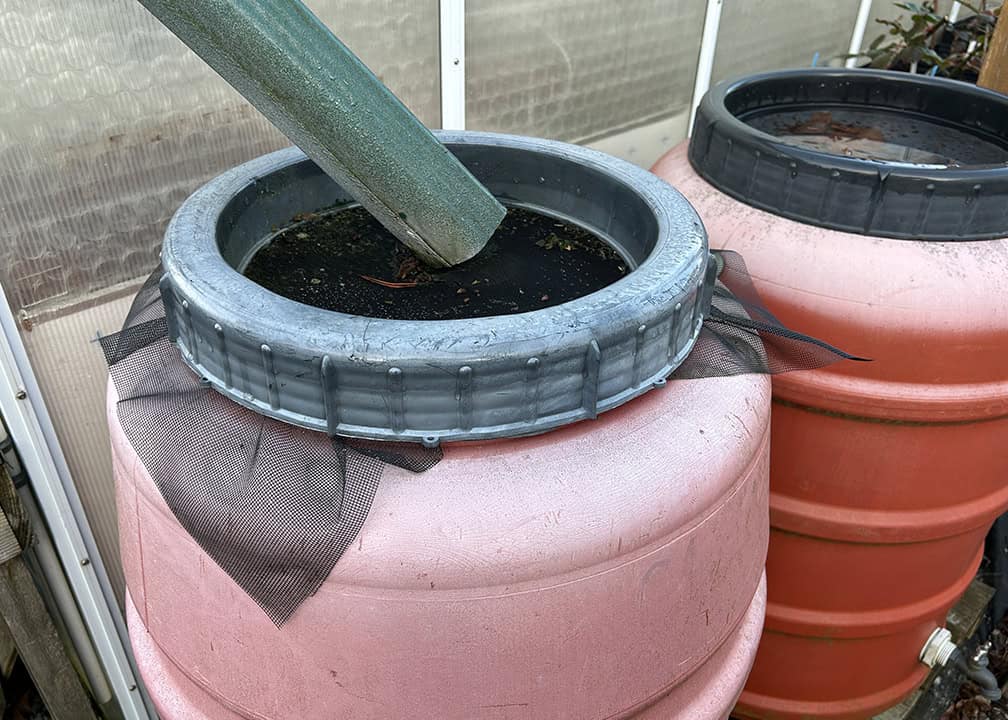
Direct the downspout so it flows directly into a rain barrel with a mesh guard on top to keep debris and mosquitoes out of the barrel. Photo © Skagit Master Gardener Foundation
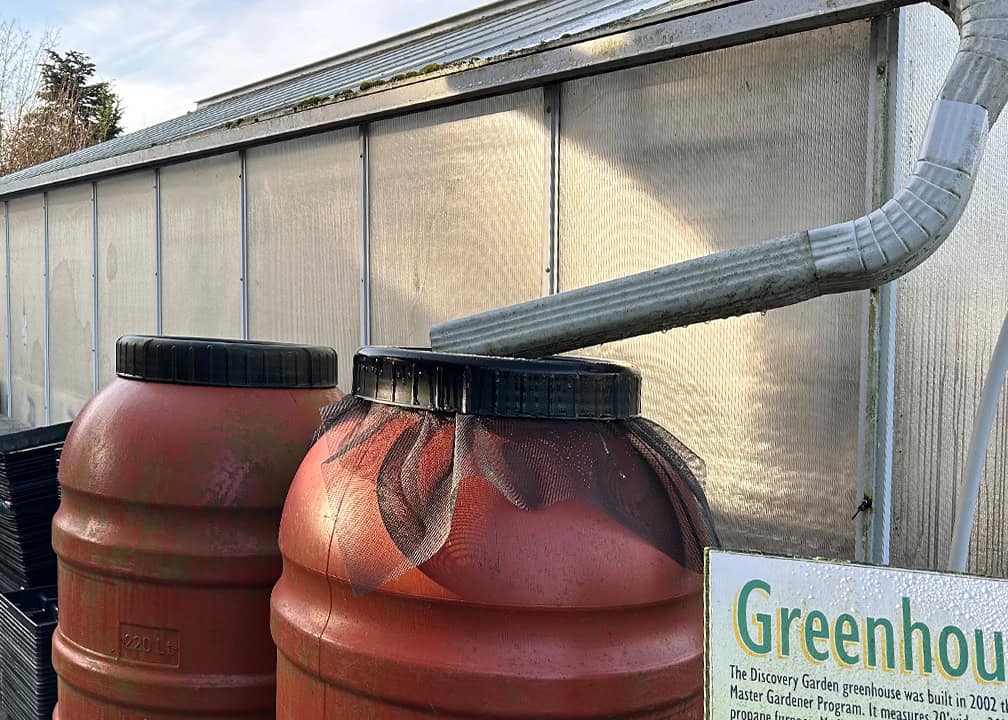
Multiple rain barrels at the Discovery Garden, west of Mount Vernon, provide all of the water needed for seed starting and plant propagation until mid-April. Photo © Skagit Master Gardener Foundation
Alternatively, you can install a downspout diverter that temporarily diverts rainwater from the downspout into the barrel. When the barrel is full, the diverter shuts off access to the barrel, and the rainwater flows down the spout once again.
Once you have decided where you want to place your rain barrels, what next? A 55-gallon rain barrel full of water weighs over 400 pounds. You need a sturdy base to support such a heavy weight and keep it level. The barrel also needs to be elevated enough that you can fit your watering can under the spigot and enough to provide water pressure if you are using a hose to empty the barrel.
The Skagit PUD site listed at the end of this article includes some tips on connecting a series of rain barrels together to increase the amount of rainwater you can store. Other sites offer options, as well.
Make sure you put a mesh guard on top of your rain barrels to keep mosquitoes from laying eggs in them, and remember to clean off the guard regularly to prevent it from getting clogged with debris washed down the downspout.
Use a clean, food-grade container to ensure you start with a barrel free of pollutants. The container should be opaque to keep out sunlight and prevent algae growth. Since you won’t be irrigating your plants in the winter (they won’t be growing and will get plenty of rain anyway), take the opportunity to rinse out your barrels. If you store them upside down, you won’t have to worry about them collecting water and freezing over winter, which might cause them to crack. You can set them up again in March or April when temperatures warm, plants start to grow, and there’s still lots of rain to catch.
There are several factors that affect how clean the water coming off your roof is. These include your location, the composition of your roof, and whether your roof has recently been treated with chemicals to control moss or algae. WSU publication #FS280E, “Potential Contaminants in Residential Rain Barrel Water” (see resources at the end of this article), goes over these issues in detail. To be on the safe side, avoid irrigating vegetable gardens with rainwater collected from roofs. Reserve it instead for ornamental plants in your yard and containers.
A number of online sites have useful resources on rainwater collection for our region. The Centers for Disease Control and Prevention has a page on rainwater and health. Washington State Department of Ecology covers rules for collecting rainwater. Skagit County Public Utility District has information on constructing, installing, and maintaining rain barrels. Washington State University Extension goes over potential contaminants in rain barrel water, and US Climate Data gives rainfall averages where you live if you want to calculate for yourself just how much rainwater you might be able to collect. Use the formula 0.623 gallons x square footage of the catchment area x inches of rain per month or year, depending on the length of time.

Know & Grow Series
Composting and Vermiculture for the Home Gardener
Tues., March 17 , 2026 — 1 p.m.
— Free, no registration required —
at the NWREC Sakuma Auditorium
16650 State Route 536, Mount Vernon, WA
RESOURCES:
Collecting Rainwater and Your Health. (2024) US Centers for Disease Control
Soak up the Rain. US Environmental Protection Agency.
Rainwater Collection. Department of Ecology State of Washington
US Climate Data – Mount Vernon, Washington
Chalker-Scott, L. (Rev. 2025) Potential Contaminants in Residential Rain Barrel Water. WSU Extension Publications #FS280E Washington State University, Pullman, WA
Tate, K. Rain Barrels 101: DIY Tips & Tricks for Collecting Rainwater. Skagit Public Utility District, Mount Vernon, WA
ABOUT THE AUTHOR: Jane Billinghurst became Skagit County WSU Master Gardener in 2005.
Questions about home gardening or becoming a master gardener may be directed to Skagit County WSU Extension Office, 11768 Westar Lane, Suite A, Burlington, WA 98233; by phone: 360-428-4270; or via the Skagit County WSU Extension website.
Washington State University Extension helps people develop leadership skills and use research-based knowledge to improve economic status and quality of life. Cooperating agencies: Washington State University, US Department of Agriculture, and Skagit County. Extension programs and policies are available to all without discrimination. To request disability accommodations contact us at least ten days in advance.