
rabbit eating grass blade
© Adobe Stock

Post: August 7, 2026

Subscribe to the Blog >

Managing Medium-sized Vertebrate Pests

Proper identification of these medium-sized, fuzzy pests is essential as management techniques differ for each species.

By Alison Hitchcock, WSU Extension Skagit County Master Gardener

Unlike the vertebrate pests covered in our previous article (rodents, moles, and shrews), the mammals addressed here are often valued for their aesthetic appeal. Yet in some circumstances, these animals damage gardens and are serious nuisances when inside homes.

RABBITS

The rabbit in your yard is probably the introduced eastern cottontail, roughly 17 inches in length, light brown with tail visibly white on the underside.

Rabbits eat grass, wildflowers, and garden crops. Most damage occurs in spring when rabbits feed on newly emerging seedlings. Larger and less tender plants are not as palatable. Rabbits snip stems with clean, 45-degree angled cuts close to the ground. Winter diets shift to buds, twigs, inner bark, and conifer needles.

Barriers are most effective for control. Install fences of 2- to 3-inch mesh 3 feet high and extend 6 inches underground to discourage burrowing. Wrap vulnerable trees and shrubs with hardware cloth, wire cylinders, or plastic tubes. Commercial repellent sprays may work for a limited time and be practical for small areas, but not entire yards.

rabbit by plant start
Most damage occurs in spring when rabbits feed on newly emerging seedlings. Larger and less tender plants are not as palatable. Photo © Adobe Stock
squirrel eating a nut in tree
It is difficult to reduce the population of tree squirrels once they are established. Discourage their access to easy food by squirrel-proofing bird feeders. Photo © Nancy Crowell Photography

TREE SQUIRRELS

Washington is home to four native and two introduced tree squirrels. The species most common to yards is the non-native Eastern Gray Squirrel.

Tree squirrels are opportunistic foragers, eating a variety of foods, though seeds and nuts are their mainstay. Squirrels dig up bulbs, eat ripened fruits, empty bird feeders, and bury nuts in landscaped areas. Tree squirrels will strip the bark off red cedar and other trees to line their nests.

Attics, basements, sheds, and other structures are attractive nesting locations and a place to gnaw on whatever is available to maintain the length and sharpness of their continually growing teeth. Reducing squirrel populations is difficult. You can remove nut trees from your yard, install squirrel-proof bird feeders, and encourage neighbors not to feed them.

RACCOONS

Raccoons are omnivorous. Plant foods encompass all kinds of fruits, nuts, acorns, corn, and grains. Animal foods include shellfish, eggs, small animals, and birds. Raccoons do not typically dig holes in lawns but may roll back sections of sod in search of insects and grubs. In addition to backyard offerings, raccoons scavenge from garbage cans and compost piles. Unsecured trash cans, pet food left outside, bird feeders, and fish ponds rank high as food sources.

Raccoons are generally nocturnal. They move to different dens or daytime rest areas every few days. Raccoons urinate and defecate in communal sites called latrines. These can be found at the base of trees or in tree forks, woodpiles, decks, attics, or roofs. Fecal matter is often contaminated with roundworm eggs and harmful bacteria.

It is more important to keep raccoons out of your home than out of your garden. Most raccoons seeking to nest in your attic or basement are pregnant females. Preventative maintenance to eliminate points of entry is the most effective means to keep raccoons outdoors.

raccoon sitting under eave of roof
It is more important to keep raccoons out of your home than out of your garden. Eliminate points of entry. Photo © Adobe Stock
raccoon eating dumped trash
Unsecured trash cans, pet food left outside, bird feeders, and fish ponds rank high as food sources for raccoons. Photo © Adobe Stock
chipmunk eating nut
Chipmunks cause the most destruction by uprooting plants and tunneling under foundations. Photo © Adobe Stock

flower icon for WSU Master GardenerMark Your Calendar for These Free Know & Grow Workshops

Ways You Can Help Your Backyard Birds
Tuesday, August 18, 2026
1:00 pm – 2:30 pm
Spectacular Fall Color – How You Can Have it in Your Garden
Tuesday, September 15, 2026
1:00 pm – 2:30 pm
Prepare Your Garden for Fall and Winter
Tuesday, October 20, 2026
1:00 pm – 2:30 pm
Creating an Award-Winning Display Garden for the NW Flower and Garden Festival
Tuesday, November 10, 2026
1:00 pm – 2:30 pm
Sakuma Auditorium
16650 SR 536, Mount Vernon, WA 98273

CHIPMUNKS

Chipmunks are solitary omnivores feeding on nuts, seeds, fruit, worms, eggs, small arthropods, and amphibians. While they may damage fruits and bulbs, burrowing activities cause the most destruction by uprooting plants and tunneling under foundations.

Burrows are typically 20-30 feet in length with escape tunnels and side chambers for nesting and food storage. Burrows are hidden near woodpiles, stumps, and brush piles and have no obvious dirt mound to mark entry points. Chipmunks enter a semi-hibernation during the winter, waking periodically to dip into their food caches.

You are more likely to see chipmunks feeding below bird feeders rather than in them, so keep the area clean beneath feeders. Minimize debris and woodpiles near structures to reduce burrowing near foundations.

PORCUPINES

Porcupines are nocturnal rodents spending days at rest in trees or rocky areas. Porcupines are strict herbivores feeding on herbaceous material in the spring and woody plants in winter. They are particularly attracted to fruit trees, but the worst harm is the stripping and eating of inner bark off young trees. Basal girdling is common on conifer saplings as well as debarking on upper boles and larger branches.

Exclusion by fencing is the most effective method for preventing porcupine damage. Place wire mesh or a band of aluminum flashing around tree trunks to exclude access to tree crowns. Trapping is actually an effective control technique, as porcupines from surrounding areas will be slow to reinvade an area.

porcupine eating bark in tree
Porcupines feed on herbaceous material such as tree bark. Photo © Adobe Stock
fencing around base of tree
As shown here, exclusion fencing of wire mesh or a band of aluminum flashing around tree trunks is very effective. Photo © Skagit County Master Gardener Foundation
river otter on dock
Though incredibly cute, river otters can easily clear out small fish ponds and may nest under your house if you live close to a water source. Photo © Adobe Stock

RIVER OTTERS, SKUNKS, WEASELS

As a group, skunks, river otters, and weasels do limited damage to gardens but become a nuisance when living under porches, outbuildings, or homes. All have scent glands that emit strong, repellent odors. Skunks are mild-tempered, nocturnal, and solitary omnivores. They may damage lawns by digging small pits in search of grubs and other insects. River otters are carnivorous, eating mostly aquatic organisms including shellfish, crabs, and amphibians. They can easily clear out small fish ponds and may nest under your house if you live close to a water source. Weasels are ferocious predators that typically live near water bodies but rarely enter homes. They prefer to eat small rodents but also take squirrels, chipmunks, shrews, moles, rabbits, snakes, and amphibians. Except for their penchant for raiding chicken coops, weasels are a great way to control other vertebrate pests in yards.

According to Washington Department of Fish and Wildlife regulations, property owners can legally trap/kill nuisance animals. Kill trapping of game species requires a special permit, which may only be obtained if non-lethal control methods prove ineffective. No permit is necessary for the use of live (cage) traps, but capture and relocation of wildlife off your property is prohibited; a captured animal must be killed or released elsewhere on the property. Euthanasia guidelines consider drowning, live burial, and freezing to be inhumane. Suitable methods for killing include injections of specific pharmaceuticals, carbon monoxide poisoning, or a gunshot to the head.

Trapping outdoors as a removal technique is generally ineffective; without habitat modifications, most nuisance wildlife will repopulate areas soon after control efforts have ceased. Consider controlling outdoor populations by removing attractants, animal proofing structures, and installing suitable fencing and screening.

References:

Pehling, D. Principles of Vertebrate Pest Management, Washington State University, accessed 10 July 2021..

Species & Habitats, Washington Department of Fish and Wildlife, 10 July 2021

Trapper Education in Washington State, Washington Department of Fish and Wildlife.

Maser, C. Mammals of the Pacific Northwest: From the Coast to the High Cascades. Corvalis: Oregon State University Press, 1998

Alison Hitchcock

ABOUT THE AUTHOR:

Alison Hitchcock has been a Skagit County WSU Extension Master Gardener since 2001. Prior to retirement, Alison worked for the Department of Natural Resources as the Northwest Regional Silviculturist.


Questions about home gardening or becoming a master gardener may be directed to Skagit County WSU Extension Office, 11768 Westar Lane, Suite A, Burlington, WA 98233; by phone: 360-428-4270; or via the Skagit County WSU Extension website.

Washington State University Extension helps people develop leadership skills and use research-based knowledge to improve economic status and quality of life. Cooperating agencies: Washington State University, US Department of Agriculture, and Skagit County. Extension programs and policies are available to all without discrimination. To request disability accommodations contact us at least ten days in advance.


lawn with hills of dirt made by moles
© Adobe Stock

Post: July 17, 2026

Subscribe to the Blog >

Small and Fuzzy but Pests Nonetheless

Proper identification of these small, fuzzy pests is essential as management techniques differ for each species.

By Alison Hitchcock, WSU Extension Skagit County Master Gardener

Vertebrate pests, while not as prevalent or pervasive as disease or invertebrate problems, can often make life miserable for gardeners. Pests damage gardens by feeding on plants, eating and disturbing roots, and burrowing under lawns. Problems can be managed indirectly by exclusion, sanitation, and habitat modification or actively through trapping or pesticides. Proper identification of the pest is essential as management techniques differ for each species. In August, the second article of this two-part series will address medium-sized pests.

Moles

Moles are solitary, territorial mammals, spending most of their lifetime underground. Populations average 2-3 adults per acre. Moles are well-adapted to a subterranean existence with large forefeet bent sideways for digging, reversible fur that permits backward movement, and small hips for turning. Eye and ear openings are protected by fur. Though often blamed for the destruction of garden plants and bulbs, moles are strict carnivores that feed on insects, grubs, and earthworms. However, it is the burrowing habits of moles that damage lawns and disrupt plant roots.
Moles construct large and complex tunnel systems with separate areas for living and hunting. Shallow, or feeding tunnels, appear as long, 1-3-inch-wide ridges of raised ground just below the soil surface. These tunnels feel spongy and soft when walked on and are often located along house foundations, sewer lines, or lawn borders. Deep runways are generally 3-12+ inches underground. These are regularly used passageways for travel between nest and feeding tunnels. Molehills occur where the animal is establishing new burrows or repairing existing ones.
Moles may work one section of their tunnel system for a few days and then move to a portion of the system in your neighbor’s yard. They are most active after periods of rain or watering, when the soil texture is ideal for digging.
Trapping is the most successful and practical method of control and is best done in early spring before they give birth. A variety of traps are available (body-gripping traps, however, are illegal in Washington). Set traps in active surface tunnels. If nothing is snared in two days, try a different run. Smacking a shovel on the ground above an actively burrowing mole will quickly kill it. Flooding can work if systems are not too extensive. Since moles feed on insects and worms, they do not readily take poisoned baits.
Unfortunately, extermination is impractical. New moles will eventually re-enter your garden if suitable conditions exist.

mole tunnel diagram
A mole burrow system showing the appropriate trap placement on a long stretch of tunnels. Photo courtesy of Iowa State University Extension and Outreach

chewed up tomato on vine

Tomato damage from rat. © Denny Organ

Rats

Two species of rats plague our area. Norway (brown/sewer) rats are large, stocky rodents with tails shorter than their bodies. Their burrows are found along building foundations, beneath woodpiles, and in moist areas around gardens and fields. Inside buildings, they usually remain at lower levels. Roof rats (black) are agile climbers, usually nesting and living above ground in trees and shrubs. In buildings, they are commonly found at higher levels in walls and attics. Roof rats have tails longer than their bodies and have sleeker shapes.
Rats will eat vegetables, seeds, and fruits but need animal protein and fat in their diet. Compost piles with only vegetable matter will not sustain a colony, though the addition of table scraps, including meats, grains, or oils, will attract rats to the pile.
Control includes rodent-proofing buildings, sanitation, trapping, or poisoning. All quarter-sized openings  (1/2″) should be sealed with rat-proof materials such as wire mesh or sheet metal. Sanitation measures include tight-fitting garbage lids and no outside pet food. Although there are many products for poisoning rats, trapping can be very effective and eliminate harm or death of non-targeted animals. When trapping, place multiple snares close to activity. Position traps against and perpendicular to walls to catch rats traveling in both directions. Bait-peanut butter is a reliable one-and set traps; use gloves as human scent may repel rats. Most importantly, let the rats take the bait several times from unset traps before setting the traps.

chewed carrot top at the surface of the soil.
Damage done to carrots by voles. Photo by Tony Koski / Colorado State University Extension.

flower icon for WSU Master GardenerMark Your Calendar for These Free Know & Grow Workshops

Ways You Can Help Your Backyard Birds
Tuesday, August 18, 2026
1:00 pm – 2:30 pm
Spectacular Fall Color – How You Can Have it in Your Garden
Tuesday, September 15, 2026
1:00 pm – 2:30 pm
Prepare Your Garden for Fall and Winter
Tuesday, October 20, 2026
1:00 pm – 2:30 pm
Creating an Award-Winning Display Garden for the NW Flower and Garden Festival
Tuesday, November 10, 2026
1:00 pm – 2:30 pm
Sakuma Auditorium
16650 SR 536, Mount Vernon, WA 98273

Mice

Two common mouse species are the house/field mouse and deer mouse. The former are often found in residences, but the latter prefer to stay outdoors or in outbuildings. Deer mice differ from house mice by being slightly larger, having a white underbelly, and a furry, rather than scaly, tail. House mice spread some diseases, but deer mice carry hantaviruses.
Mice eat cereal grains and seeds but may eat bulbs or corms and small fruits. Mice rarely burrow but can gain entrance to homes through dime-sized holes (1/4″). They will chew on just about anything that may be useful in nest building.
Mice are easily trapped. Place snap traps in areas where rodent activity (droppings, nests, chewed materials) is occurring.  If opting to use poison, use secured block baits; deer mice tend to cache food, leaving no bait for other rodents.

mole just above the surface of soil
Mole control is best done in late winter/early spring before they give birth. © Adobe Stock
mouse on cheese
House and field mice eat cereal grains and seeds but may also eat bulbs, corms, and small fruits. © Adobe Stock
vole in woods
Voles are strict vegetarians – grass, bulbs, fruits, barks, leaves and succulent root systems are favored. © Adobe Stock

Voles

Unlike mice, voles have small ears, short legs and tails, and blunt noses. Voles are strict vegetarians, chewing on soft, green vegetation, grass, bulbs and succulent root systems. They often uproot plants and can girdle young trees and shrubs by removing bark at the base. They construct short, shallow burrows and surface runways through lawns and sometimes inhabit abandoned mole tunnels.
Voles rarely enter buildings. They frequent grassy ground cover and weedy areas, so anything that reduces vegetative cover such as mowing or tillage will help control them. To protect young trees from girdling, keep vegetation 4′ away from trunks and protect with ¼” hardware cloth. Voles can be captured with mousetraps set in tunnels and runways.  Stomping and filling of mole tunnels will help to eliminate their use as underground passages for voles.  

Shrews

Although commonly mistaken for voles or mice, shrews have pointed noses and five, rather than four, toes on front legs. Similar to moles, shrews live primarily on insects such as caterpillars and centipedes but also eat other garden pests: snails, slugs, and small mice. They do not create surface tunnels but often feed on runways or tunnels made by other mammals. Shrews are generally beneficial to gardens and should not be eliminated unless they become a nuisance.

While total extermination of these fuzzy pests is difficult, combining different approaches can help reduce garden damage. Practical management strategies for each pest, such as trapping, exclusion, and sanitation, stresses the need for first accurately identifying the vertebrate causing the damage.

References:

Maser, C. Mammals of the Pacific Northwest: From the Coast to the High Cascades. Corvalis: Oregon State University Press, 1998

Living with Wildlife: Moles,Washington Department of Fish and Wildlife, accessed 14 June 2021.

Pehling, D. Principles of Vertebrate Pest Management, Washington State University, accessed 14 June 2021.

Moles: Damage Management, Iowa State University Extension and Outreach, accessed 14 June 2021.

Rodents, Washington State Department of Health, accessed 14 June 2021

Alison Hitchcock

ABOUT THE AUTHOR:

Alison Hitchcock has been a Skagit County WSU Extension Master Gardener since 2001. Prior to retirement, Alison worked for the Department of Natural Resources as the Northwest Regional Silviculturist.


Questions about home gardening or becoming a master gardener may be directed to Skagit County WSU Extension Office, 11768 Westar Lane, Suite A, Burlington, WA 98233; by phone: 360-428-4270; or via the Skagit County WSU Extension website.

Washington State University Extension helps people develop leadership skills and use research-based knowledge to improve economic status and quality of life. Cooperating agencies: Washington State University, US Department of Agriculture, and Skagit County. Extension programs and policies are available to all without discrimination. To request disability accommodations contact us at least ten days in advance.


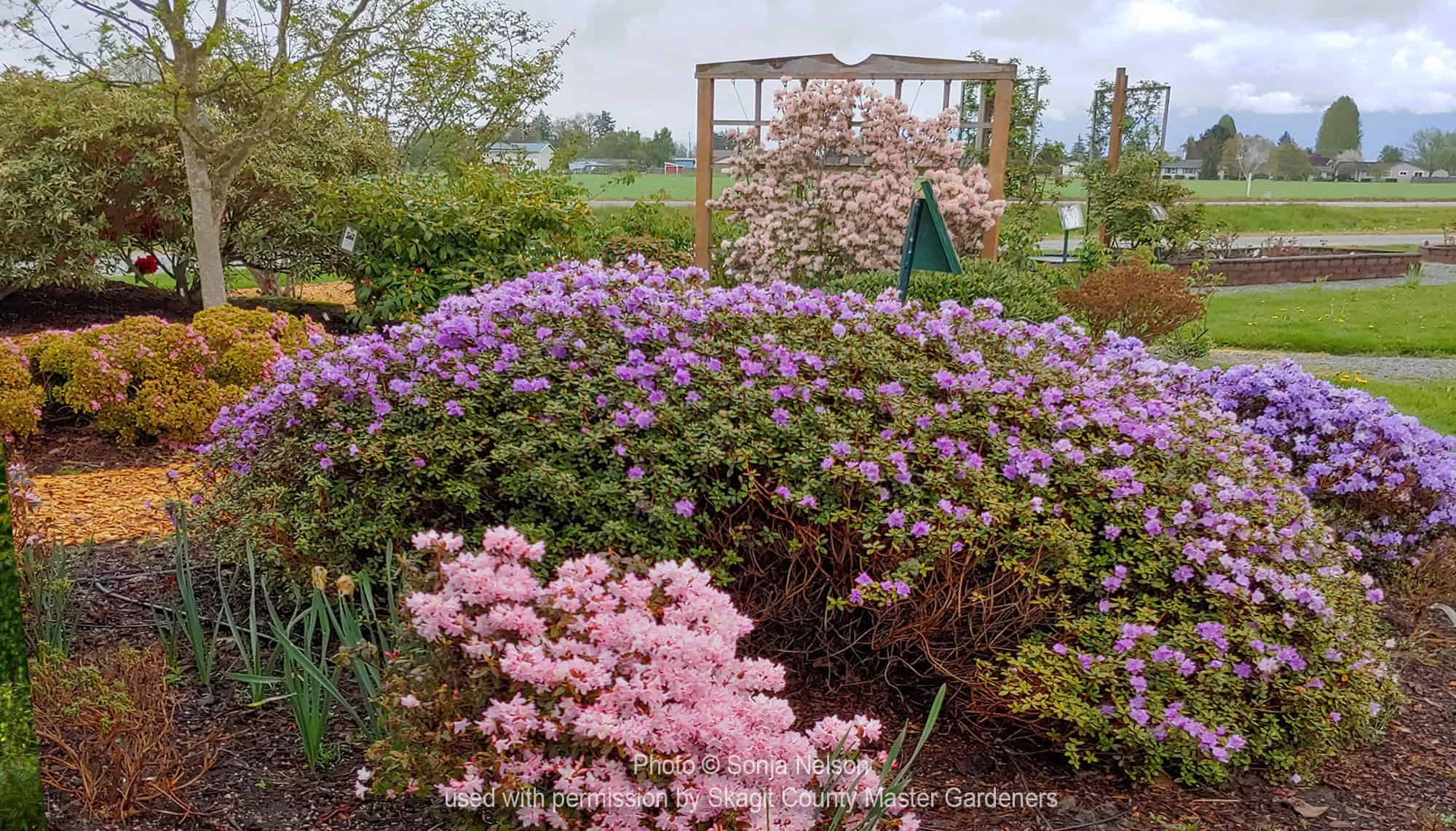
© Sonja Nelson
graphic for Ask a Master Gardener masthead with flower

Warmer Summers Impact Local Rhododendrons

From sun scorch to lace bug, local gardeners protect their beloved rhododendrons with these conscientious tips.

              Subscribe to the Blog >

By Sonja Nelson, Skagit County WSU Extension Master Gardener

Author Sonja Nelson

Rhododendrons in our gardens, along with the native state flower Rhododendron macrophyllum, the Western or Pacific rhododendron in our woodlands, are facing the vagaries of climate change here in the Pacific Northwest as well as worldwide. Gardeners in our moderate climate can no longer assume our benevolent climate will continue its unstinting support for the genus Rhododendron. According to the World Meteorological Organization, the average global temperature in 2024 was the warmest year on record at about 2.7° F or 1.55° C above preindustrial levels. Higher temperatures do not bode well for rhododendrons. They like moderation!

Rhododendrons have a long history in the Pacific Northwest. Native Americans used the flowers of rhododendrons in their dance rituals long before western plant hunter Archibald Menzies identified the R. macrophyllum. Menzies was the surgeon-botanist for Captain George Vancouver on board the British ship ‘Discovery’ in 1792. The R. macrophyllum, or Western rhododendron, was sent to King George III and introduced to the Kew Gardens in London. The discovery brought together the British and American plant people who eventually produced a creative milieus communities of rhododendron enthusiasts that made the rhododendron the “King of Shrubs” on both sides of the Atlantic.

pink rhododendron blooms in woods

References to the Western rhododendron (Rhododendron macrophyllum) date back to native Americans using rhododendron flowers in their dance rituals long before the late 1700s. © Photo: Sonja Nelson

One hundred years after Menzies documented finding the Western rhododendron, the state of Washington sought a representative flower to display in the 1893 Chicago World Fair exhibit. The Washington State Fair Commission asked the state’s women to decide. A letter-writing campaign began, pitting the native rhododendron against, among others, the clover. (The vote was Western rhododendron 7,704 and clover 5,729.) It was officially designated the Washington State flower in 1959.

However, between the time the Western rhododendron was presented at the Chicago World Fair, rhododendron species from Asia, particularly the Himalayas, had been discovered by dedicated British plant hunters and sent back to Britain to adorn gardens there with their vibrant colors and to hybridize. Many Asian species and hybrids were also brought to America, where nurseries introduced them to the Pacific Northwest. Gardeners welcomed them with enthusiasm and love. And the rhodies loved them back with their stunning performance!

Meanwhile, Washington state’s native Western rhododendron grew in its native woodlands as the quietly attractive relative of the more flamboyant Himalayan species. In the 1970s the Western rhododendrons regained popularity as gardening with native plants became popular with the backing of  WSU Extension and the Washington Native Plant Society. In 1979, the First World Climate Conference declared climate change a global issue, and rhododendron gardeners’ concern turned to the native Western rhododendron and its environment, along with concern for their rhododendron species and hybrids from afar. The natural environment of the Pacific Northwest, so well suited for much of the genus Rhododendron, was becoming jeopardized by temperature increases and other disturbances to its blissful climate.
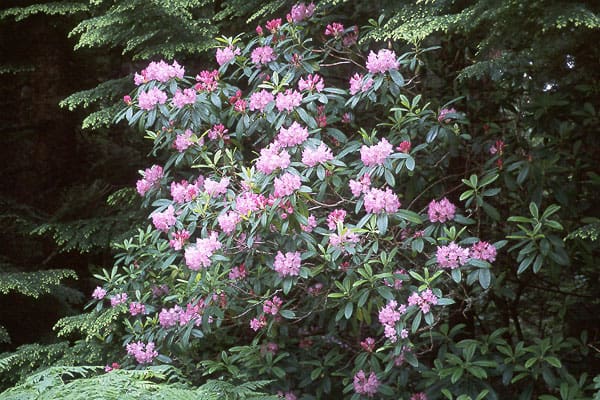
pink rhododendron bush blooming in garden
The Western or Pacific rhododendron is native to the woodlands of the Pacific Northwest. Image © Oregon State University
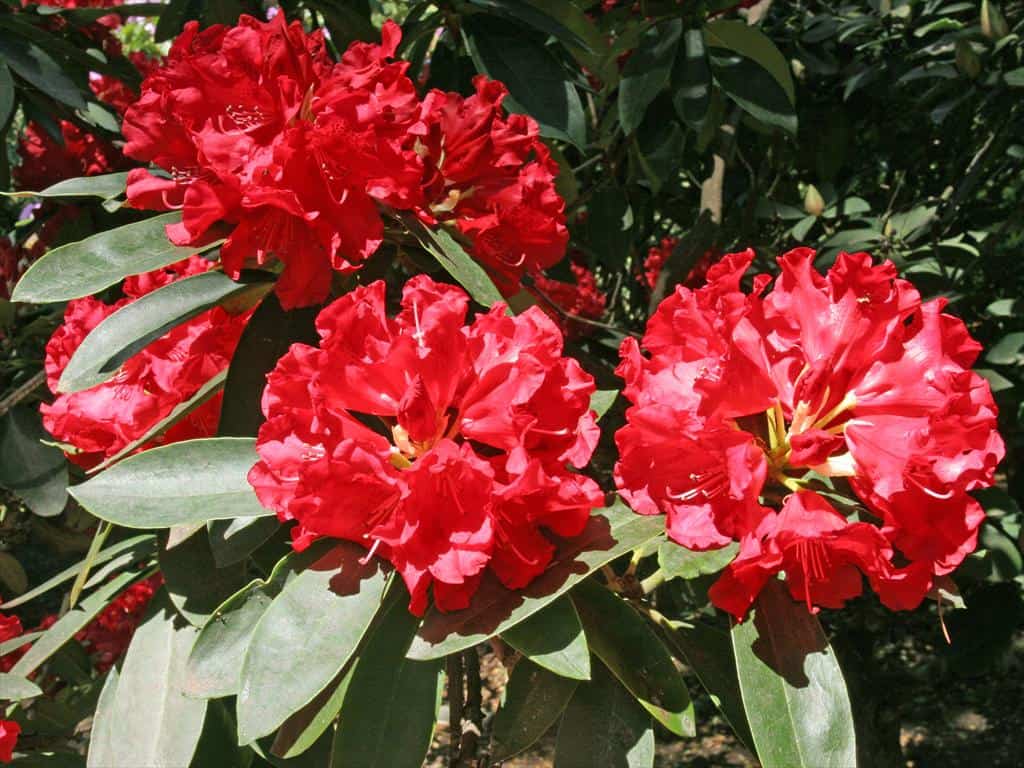
bright red blooms of Jean Marie rhododendron
One of the most sun-hardy of all rhododendrons, the Jean Marie Rhododendron is noted for its large trusses of deep red, trumpet shaped flowers. © WSU Clark County

The complexity of a warming climate makes it difficult to predict precisely how rhododendrons will be impacted by our specific climate and what to do if it does. For instance, if temperatures increased enough to leave visible sun spots on the leaves of rhododendrons, the rhododendrons could simply be moved to a site with partial shade. However, the effect of a warming climate on plants is not always straightforward.

One solution to protect rhododendron gardens from climate change damage is to find varieties-both species and hybrids-that are tolerant of temperature increase and ensuing weather extremes.

A member of the American Rhododendron Society, C.J. Patterson of Massachusetts, has focused his interest in rhododendrons on finding drought-tolerant rhododendrons for East Coast gardens. He writes that “rhododendrons, in general, are mostly very resistant to dry conditions once they are established,” citing R. carolinianum, R. maximum, and R. catawbiense as drought tolerant. He says one of the most drought-tolerant rhododendron hybrids is the hybrid ‘PJM’ (R. minus var. Carolinian Group x R. dauricum) and other hybrids of the same cross.

The director of the German Rhododendron Society, Hartwig Schepker, supports the idea that the genus Rhododendron is diverse enough to cope with the challenges posed by extreme climate conditions, saying we find them or create new hybrids that will be up to the job.

Another rhododendron expert is Glen Jamieson, the editor of the Journal American Rhododendron Society, who often writes about the impact of climate change on rhododendrons, which, he says, has been relatively minor annually. In coming publications, he plans to summarize the weather impacts on his garden in British Columbia over the past 40 years, where there have been extreme cold, heat, precipitation, and wind events-all of which can be attributed to a changing climate.

Since it is difficult, if not impossible, to predict precisely the effects of climate change on rhododendrons in the future, conscientious basic care is the best way to help them survive hard times in the future. Washington State University lists watering, fertilizing, and mulching as basic care.

Basic Care for Rhododendrons
Washington State University Extension recommends this regimen of basic care:

Watering

  • Water rhododendrons at least once a week, or when the top inch of soil feels dry.
  • Avoid waterlogged soil, which can damage rhododendrons.
  • Water well in the fall to prepare for winter

Fertilizing

  • Use a fertilizer made for acid-loving plants.
  • Fertilize in the spring when buds swell and in the fall after flowering.
  • Follow the product label recommendations.


Mulching

  • Use coarse organic mulch, like wood chips, to cover the root zone.
  • Keep mulch at least 4 inches deep, but don’t let it touch the base of the plant.
  • Mulch helps conserve water, reduce weeds, and moderate soil temperatures

Other Tips

  • Plant rhododendrons in well-drained acidic soil
  • Avoid dense or compacted soil
  • Provide shade or semi-shade
  • Prune out dead flowers
  • Avoid overhead watering
  • Maintain good air circulation
  • Prevent injury to reduce the chance of infection
  • Clean up and destroy fallen leaves


A Unique Opportunity to Observe Local Climate Change Impact
The coordinators of the various gardens within the WSU Extension Master Gardener Discovery Garden west of Mount Vernon were questioned about possible damage in their gardens due to recent summers with high temperatures. Five coordinators reported no change, and four coordinators reported slight changes. Ironically, six coordinators reported damage from unusual cold spells. The Rhododendron Garden coordinator, however, reported extensive damage to a large planting of small-leaved rhododendrons due to warming temperatures.
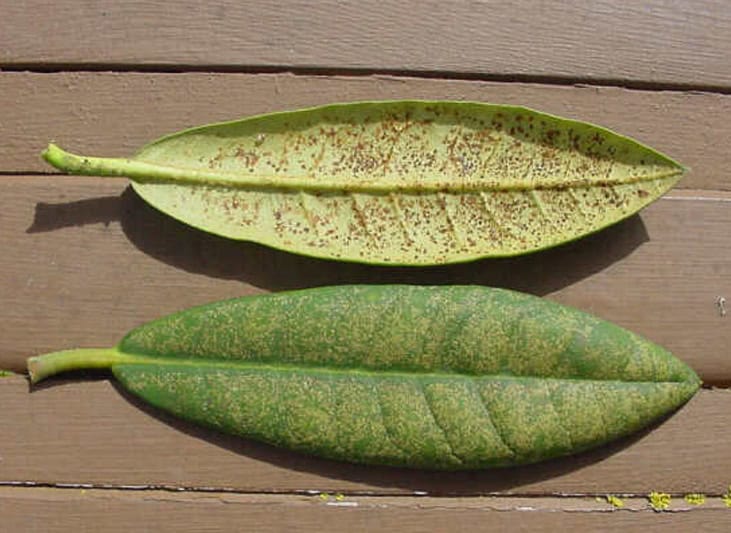
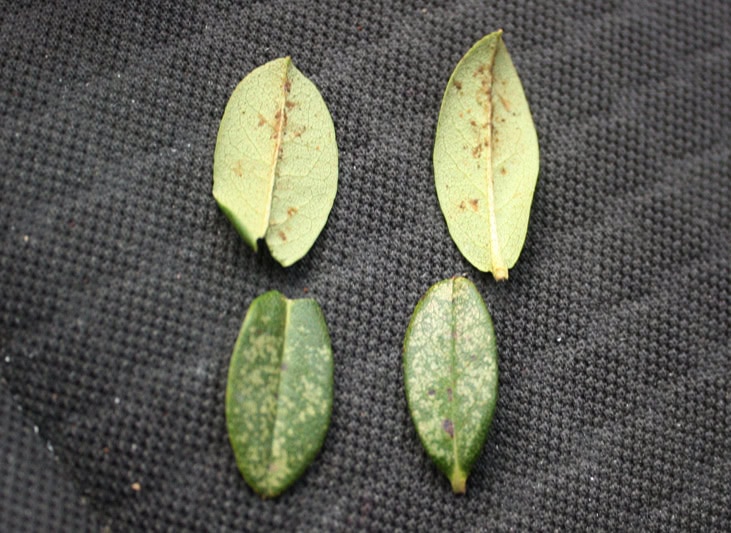
brown speckles on front and back of rhododendron leaves
Lace bug symptoms on rhododendron leaves © WSU Hortsense Photo by: C.R. Foss
bug eggs on back of rhododendron leaves
Photo © Sonja Nelson

Rhododendrons are divided into two natural divisions: the lepidotes and the elepidotes. Small-leaved rhododendrons belong to the lepidote division based on the tiny scales on the undersides of their leaves. Elepidotes do not have scales and tend to be large-leaved.

Sun scorch on the leaves of rhododendrons has long been an occasional problem for gardeners, but the warming caused by climate change has introduced a new, insidious avenue for damage–the rhododendron lace bug (Stephanitis rhododendri). Believed to have migrated from California, lace bugs have taken advantage of the longer growing season in the Pacific Northwest and can complete their life cycle, where, in 2023, in the Rhododendron Garden, it laid eggs and, as a result, destroyed a planting of rhododendrons.
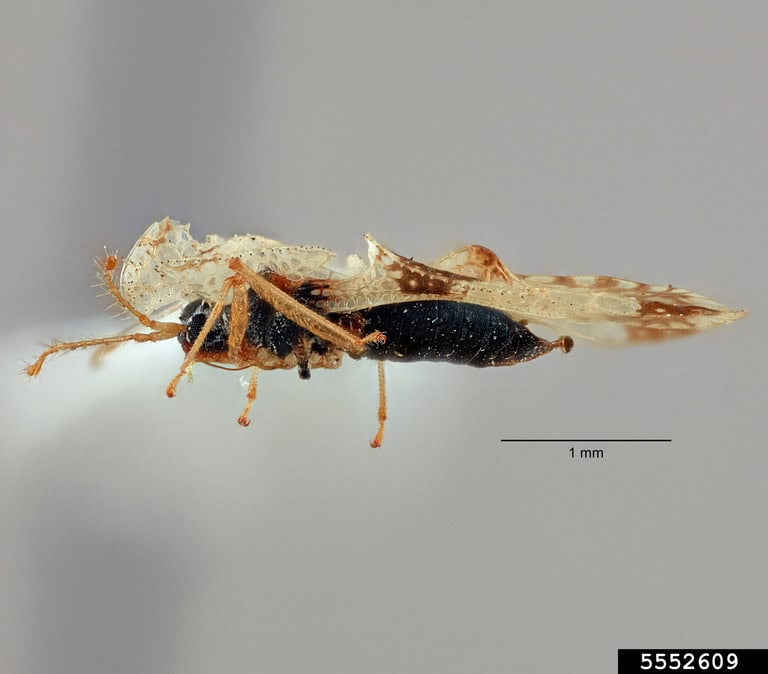
lace bug close up

Rhododendron lace bug (Stephanitis rhododendri Horvath) © Insect Images Photographers: Seastone, L. and B. Parks
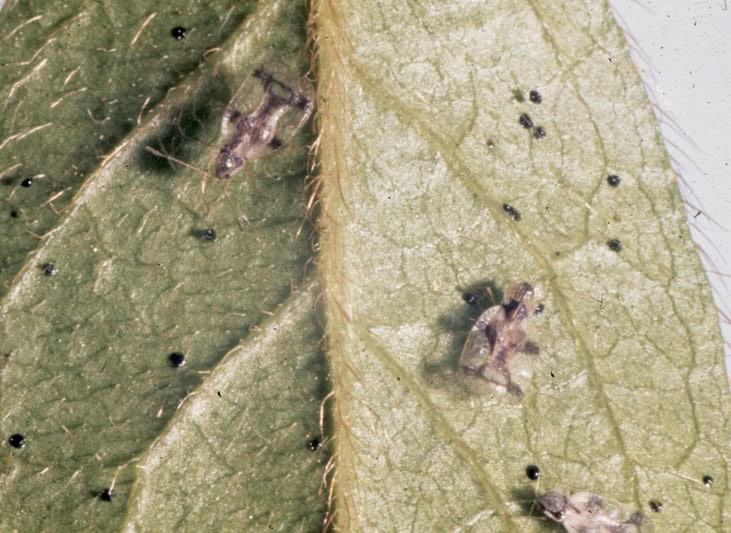
bug damage on leaves of azalea

Azalea lace bug (Stephanitis pyrioides) © Photo: Jim Baker, North Carolina State University, Bugwood.org

The lace bug affected rhododendrons with small leaves, mainly in the island meadow section of the Rhododendron Garden, namely hybrids ‘Ramapo,’ ‘Ginny Gee,’ and ‘Patty Bee.’

The rhododendron lace bug has one generation per year. It overwinters as eggs laid on the underside of leaves. Nymphs are about 1/8 inch long and are spiny. Adults are about 1/8 inch long and whitish tan with lacy-looking wings. Damage is usually apparent by early to mid-July. The lace bug sucks on the undersides of leaves and causes stippling on the upper surface of the leaves and tar-like deposits of excrement on the lower surface. Repeated infestations may result in yellowed, sickly plants. Spraying the undersides of the plants to remove the lace bugs was considered impossible because the leaves grow so densely and so close to the ground; thus the affected plants were removed. New planting will take place in 2025.

The related azalea lace bug (Stephanitis pyrioides) has four to five life cycles annually. It infects rhododendrons also but has not been found in the Rhododendron Garden section of the Discovery Garden. Both types of lace bug overwinter.
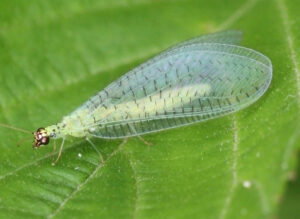
Lacewing insect © Insect Images: Photographer: Johnny N. Dell

The lace bug is not to be confused with lacewing insects (Chrysoperla species) which are native to the Pacific Northwest and important natural predators providing biological control of aphids.

Treatment for Lace Bug
For non-chemical treatment, Washington State University recommends hand removal of adults and nymphs regularly to limit the amount of visible damage. This can be done with a strong spray of water.

If you choose to use a chemical treatment, two recommended pesticides that are legal in Washington are:     

  • Safer Brand BioNEEM Multi-Purpose Insecticide and Repellent Concentrate [Organic] Active ingredient: azadirachtin [EPA registration number: 70051-6-42697]
  • Safer Brand Garden Defense Multi-Purpose Spray Concentrate [Organic]
    Active ingredient: clarified hydrophobic extract of neem oil [EPA registration number: 70051-2-42697]

The best time to treat is May and June. For more information, download the WSU fact sheet on rhododendrons and lace bugs

The Rhododendron Garden in the Discovery Garden allows the public to view plants as they grow in our specific climate. The damage to some of the small-leaved rhododendrons is sad to see, but it gives gardeners the knowledge to make necessary changes in their gardens to keep them beautiful.

Soon, spring will once again bring forth the eye-catching, luscious blooms on the rhododendron hybrids planted in our gardens and the quietly elegant blooms of our native Western rhododendron at the edges of our woodlands.

REFERENCES AND RESOURCES:
Dale-Crunk, B. (2024) Personal communication.

Global Temperature Data Indicator. NASA

Skagit Climate Science. Air Temperature and Precipitation 

Washington State University. (2024) Rhododendron: Rhododendron and Lace Bug fact sheet.

Pojar, J. and MacKinnon, A. (1994) Plants of the Pacific Northwest, B.C. Ministry of Forests and Lone Pine Publishing

Nelson, S. (Compiler) (2001) The Pacific Coast Rhododendron Story American Rhododendron Society. Binford & Mort Publishing, Portland, Oregon.

University of Washington: Pruning and Caring for Rhododendrons. 

Washington Native Plant Society (2022) Coast Rhododendron: Washington’s State Flower 

World Meteorological Organization (2025) January 2025 Sees Record Global Temperatures Despite La Niña

ABOUT THE AUTHOR:
Sonja Nelson is a Skagit County WSU Extension Master Gardener, Class of 2009.

Questions about home gardening or becoming a master gardener may be directed to Skagit County WSU Extension Office, 11768 Westar Lane, Suite A, Burlington, WA 98233; by phone: 360-428-4270; or via the website: www.skagit.wsu.edu/mg

Washington State University Extension helps people develop leadership skills and use research-based knowledge to improve economic status and quality of life. Cooperating agencies: Washington State University, US Department of Agriculture, and Skagit County. Extension programs and policies are available to all without discrimination. To request disability accommodations contact us at least ten days in advance.


AMGPost_header5
031723-header2

Midnight Marauders

Managing Those Pesky Slugs and Snails


              Subscribe to the Blog >

By Diana Wisen, Skagit County WSU Extension Master Gardener

Pacific Northwest gardeners probably spend more time discussing slug damage than almost any other garden problem. Slugs require moisture in the soil and vegetation, both of which are abundant in our area.
During cold or dry weather, they can move down into the soil. Adult slugs and snails live through the winter in this region, seeking shelter underground. In dry or hot weather, they can borrow down as much as 6 feet to find cool dampness. They can seal themselves off with a parchment-like membrane for protection from the elements. They are Gastropods from the Greek meaning “belly foot”.

Most of the slugs and snails you see in your yard are non-native, invasive varieties. The native Banana slug, a good guy, is found mostly in wooded areas, not suburban landscapes, and tends to eat only decaying matter. There are many species of non-native slugs that attack your plants.

Diana Wisen

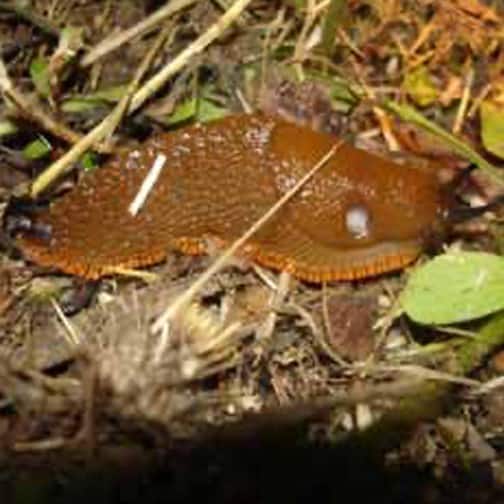
Two of the most destructive are the common gray field slug, genus Arion (several colors of these large slugs), and the brown snail that is becoming more common as it can survive drier conditions easier than slugs.

Slugs eat young vegetables starts, strawberries, daffodils and tulips, and many other things, with new dahlia shoots and marigolds being among their favorites. You have to start early and be vigilant in your efforts to manage the slug and snail population in your yard. There is no such thing as just one slug. Slugs can lay anywhere between 30 to 100 eggs at a time, several times a year, mostly in late summer. Slugs are hermaphrodites: adults have both female and male organs, so all can lay eggs. Sometimes the eggs hatch right away and other times they hatch the following spring. Look for clusters of tiny, pearl-like eggs beneath leaf debris, boards, garden pots, and other damp places and crush them immediately.

Those little eggs will soon turn into ravenous baby slugs which eat 30-40 times their body weight every day! Their teeth are like a rasp that shreds the vegetation as they glide along. Slugs tend to come out at night or on cloudy days when it is cool and damp. This is your clue as to when to head out to hand-pick. However, only about 5% of the slugs are above ground at any given time, thus making control efforts difficult and ongoing.

There are five main types of control and for best results, you may have to utilize all of them, though you will never be able to eliminate slugs completely.

Biological:
Some predators eat slugs. Toads, frogs, snakes, and beetles will eat small slugs, so encourage them in your yard. Sometimes chickens and wild birds will eat baby slugs, but gag on large slugs. Ducks and geese eat slugs, but this poultry solution is not for everyone.
Cultural:
Change the conditions so the area is not conducive to slugs. Keep the soil dry. Mow nearby meadows or grassy areas. Keep a 6-foot-wide strip of dry, bare ground around your vegetable garden, use arborist chips for pathways, till your soil in early spring to expose the slug eggs, and plant things that slugs tend not to eat. Crushed eggs shells, ashes, and diatomaceous earth do not work. The slug’s mucus thickens to protect it from sharp surfaces.
Mechanical:
People love to talk about their favorite tools for slug control.
– A sharp shovel or weeding tool, a Hori-Hori knife, an old kitchen knife or scissors, or a hoe. Keep them all handy. Many people regularly go out at night or early morning with a bucket of soapy water on a search and destroy mission. The frequency is up to you, but the more often the better the results. Be sure to wear disposable gloves as slugs carry diseases such as Salmonella. Be sure to keep a lid
on the container.
– A wide band (3″) of copper tape firmly attached around the base of containers and raised beds will prevent slugs from climbing up. They will not cross copper. But make sure there are no slug eggs in the soil already in the pot!
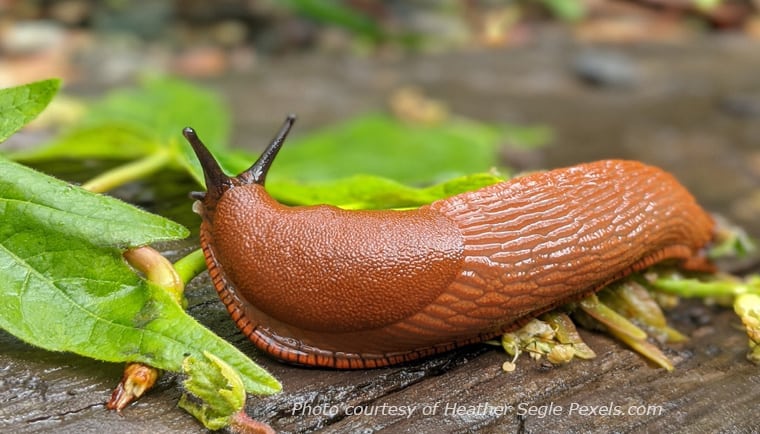
This large red slug (Arion rufus) is one of the larger slug varieties, with an appetite to
match. This photo shows the slug's round pneumostome (nose and breathing hole) and
the black optical tentacles protruding from its head. © Photo by Jason Miller.
This large red slug (Arion rufus) is one of the larger slug varieties, with an appetite to
match. This photo shows the slug’s round pneumostome (nose and breathing hole) and
the black optical tentacles protruding from its head. © Photo by Jason Miller.
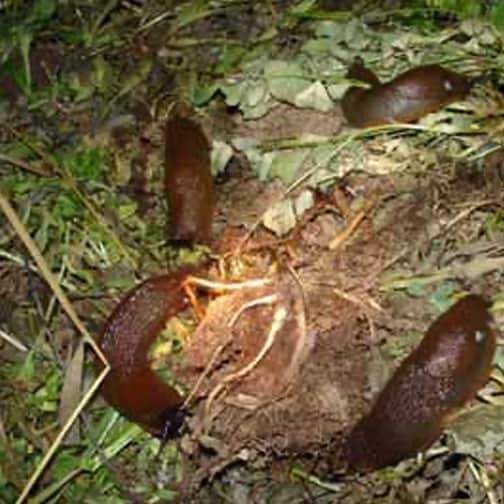
Large red slugs descend on a pile of discarded raspberry canes. With voracious appetites,
these slugs can devastate many small plants overnight, skeletonizing the leaves and
diminishing the plants' chances at survival. © Photo by Jason Miller.
Large red slugs descend on a pile of discarded raspberry canes. With voracious appetites,
these slugs can devastate many small plants overnight, skeletonizing the leaves and
diminishing the plants’ chances at survival. © Photo by Jason Miller.
Chemical:
There are many products on the market to kill slugs and snails. Read the label before purchasing and using it at home. Follow the directions exactly. The newer products are distributed differently than was done with the products of a few years back. Newer products use ferrous (iron) phosphate as the active ingredient and require only sprinkling sparsely over an area. Slugs are attracted to the bait, they eat it, and it makes them stop eating and slither away to die. You won’t see the dead bodies, but after a few days, you will notice the damage has stopped. These newer products remain active for up to 2 weeks, even if it rains. They are safe to use around children, pets, and wildlife.

There are some products available that use metaldehyde as the active ingredient and it works very well, but they can be poisonous to children, pets, and wildlife.

Home Remedies:
Do not use salt. Slugs rehydrate and salt damages your soil and plants. Fermenting yeast attracts slugs, so some people use beer. You provide the party, and the slugs show up, drink their fill and drown. It has its advantage. The slugs come to you; you don’t have to go out looking for them. You can use a cottage cheese carton, cut a couple of openings in the side, set it in the ground up to those holes, fill it with beer or your homemade brew, and put the lid on. Check and empty it every couple of days. Slugs are also attracted by the smell of dead slugs and show up to join the party. Keep your dog away since dogs are known to slurp up the whole thing, dead slugs, and all. You can use old beer, but not wine or stale beer. Apple vinegar sometimes works. You can also make your own fermenting recipe: 1 Tbsp brewer’s yeast or baking yeast, 1 Tbsp sugar, 2 Tbsp flour, and 2 cups tepid water. Mix and allowed to stand for an hour or so. It will last for 2 or 3 days.

Remember it takes regular attention and vigilance to manage slug and snail populations. Keep at it and over the years you will see a decline in the numbers you have in your yard.

About the Author:
Diana Wisen is a Skagit County WSU Extension Master Gardener and is the Coordinator of the Fuchsia Garden at the Discovery Garden on SR 536 in Mount Vernon.
References:
Gordon, David George. 2010. The Secret Life of Slugs and Snails-Life in the Slow Lane Sasquatch Books, Seattle, WA

“Managing Slugs and Snails” State University- 10-Minute University OSU Master Gardener Program and OSU Extension Service

Those Pesky Slugs” Article by Mary Robson King County Area Extension Agent (now retired) May 2000

Schenk, George. 2002. The Complete Shade Garden. Timber Press, Portland, OR

Questions about home gardening or becoming a master gardener, may be directed to:  WSU Skagit County Extension Office, 11768 Westar Lane, Suite A, Burlington, WA 98233; by phone: 360-428-4270; or via the website: www.skagit.wsu.edu/mg

Washington State University Extension helps people develop leadership skills and use research-based knowledge to improve economic status and quality of life. Cooperating agencies: Washington State University, U.S. Department of Agriculture, and Skagit County. Extension programs and policies are available to all without discrimination.  To request disability accommodations contact us at least ten days in advance.