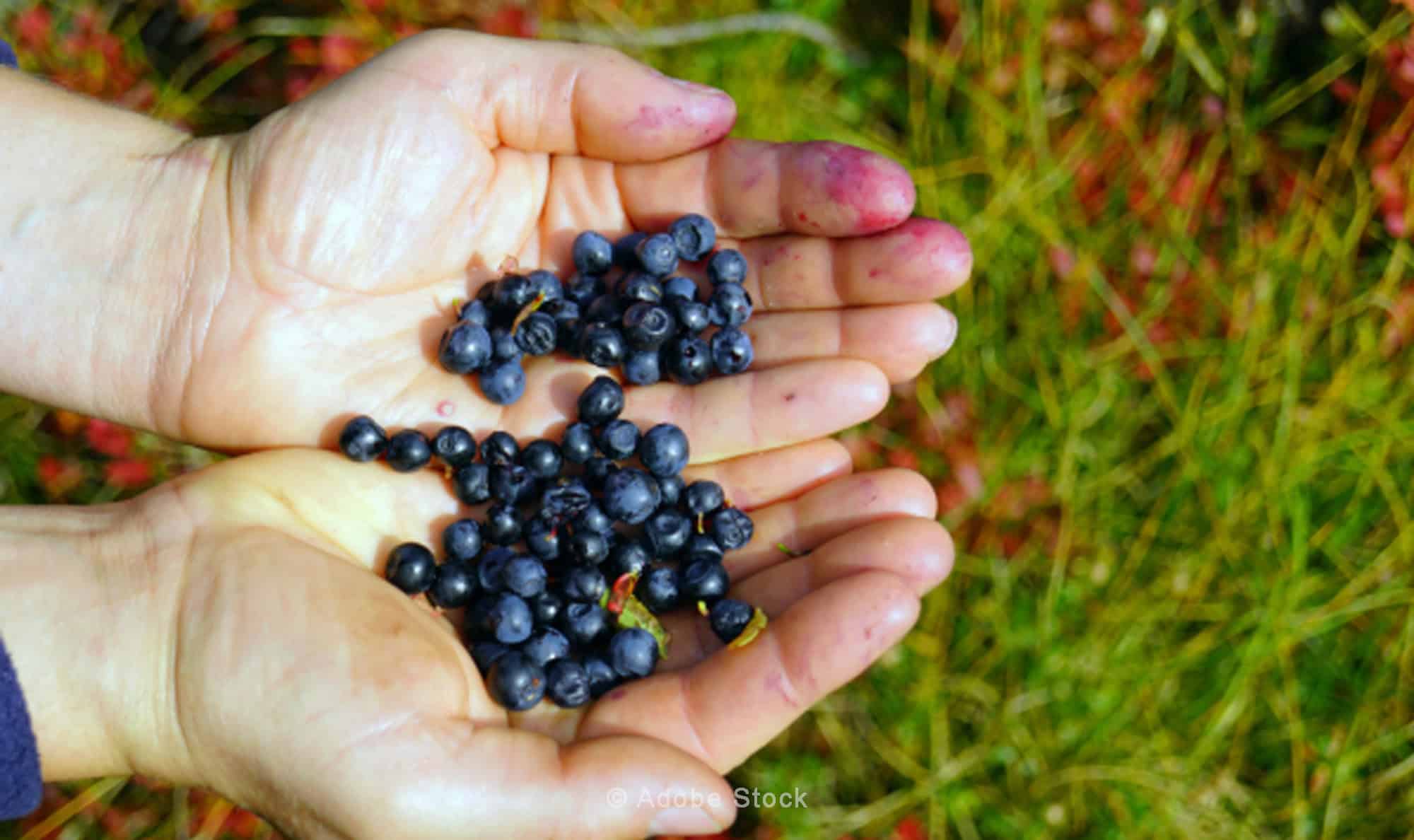
blueberries in the palm of a person's hands

Planting, growing and maintaining blueberries

Growing blueberries: Start with the right soil to get “superfood” results

How to choose blueberries well suited for success in the Pacific Northwest

Posted July 4, 2025

Subscribe to the Blog >


By Kari Ranten, Skagit County WSU Extension Master Gardener

Kari Ranten

Blueberries are a staple of Skagit County’s thriving commercial agricultural economy and are an increasingly popular plant and crop for northwest home gardeners.

Commercially, Washington leads the nation in blueberry production, with 26 percent of U.S. blueberries generating a revenue of $205 million, according to the U.S. Department of Agriculture (USDA-NASS.2025). Blueberry acreage in Skagit County increased eightfold since 2000. In 2023, 4,800 acres of blueberries were grown commercially in Skagit County, ranking third in crop acreage behind only field crops and potatoes, according to Washington State University Extension Skagit County’s Crop Acreage and Yield Report.

These strong statistics show that northwest Washington is an excellent growing environment for home and commercial production of blueberries, yielding a delicious summertime fruit crop or serving as a sturdy, attractive ornamental addition to the home landscape.

Blueberries have gained popularity among consumers for their nutritional qualities and are recognized as a “superfood,” offering an excellent source of essential nutrients, vitamins C and K, and dietary fiber. Blueberries are also a nutritional source of valuable “phyto-components,” contributing to antioxidants and anti-inflammatory qualities.

For those interested in growing blueberries in the home garden, there are some decisions and preparatory steps to take to get ready for planting from January to March.

Common varieties
Of the five main types of blueberries grown in the United States, northern highbush blueberries (Vaccinium corymbosum L.) are most common in Washington. These deciduous, perennial shrubs are shallow-rooted, take six to eight years to reach full production, and varieties can reach five to nine feet in height.

sign by highway

Researchers at WSU Mount Vernon Northwestern Washington Research & Extension Center (NWREC) play a vital role in working with commercial blueberry growers. Chakradhar Mattupalli, assistant professor of plant pathology, leads the Berry and Potato Pathology Program, conducting research and extension activities addressing the biology and management of diseases of highbush blueberry and potato crops. He provided guidance and resources in the preparation of this article. For more information about Mattupalli’s research, go to Berry and Potato Pathology | Washington State University

NWREC is one of four WSU Research Centers operated by the College of Agricultural, Human, and Natural Resource Sciences, housing nine research programs, extension outreach, and research affiliates. The research center works to solve plant-related problems and develop cost-effective and environmentally sound plant production practices based directly on results from experimental field, greenhouse, and laboratory research trials.


The publication “Blueberry Cultivars for the Pacific Northwest” notes that half-high blueberries, the result of crosses between northern highbush and lowbush blueberries, can also grow in the region and reach three to four feet tall. The cultivars are also used as attractive landscape plants and are suited to container production.

The NW Fruit Garden, next to the Discovery Garden on Memorial Highway in Mount Vernon, provides home gardeners with an excellent illustration of 30 blueberry varieties suitable to the local environment. The garden is maintained by volunteers, including Beth Jones, a NW Fruit volunteer since 2019, who leads the blueberry team charged with caring for 122 plants, some more than 20 years old.

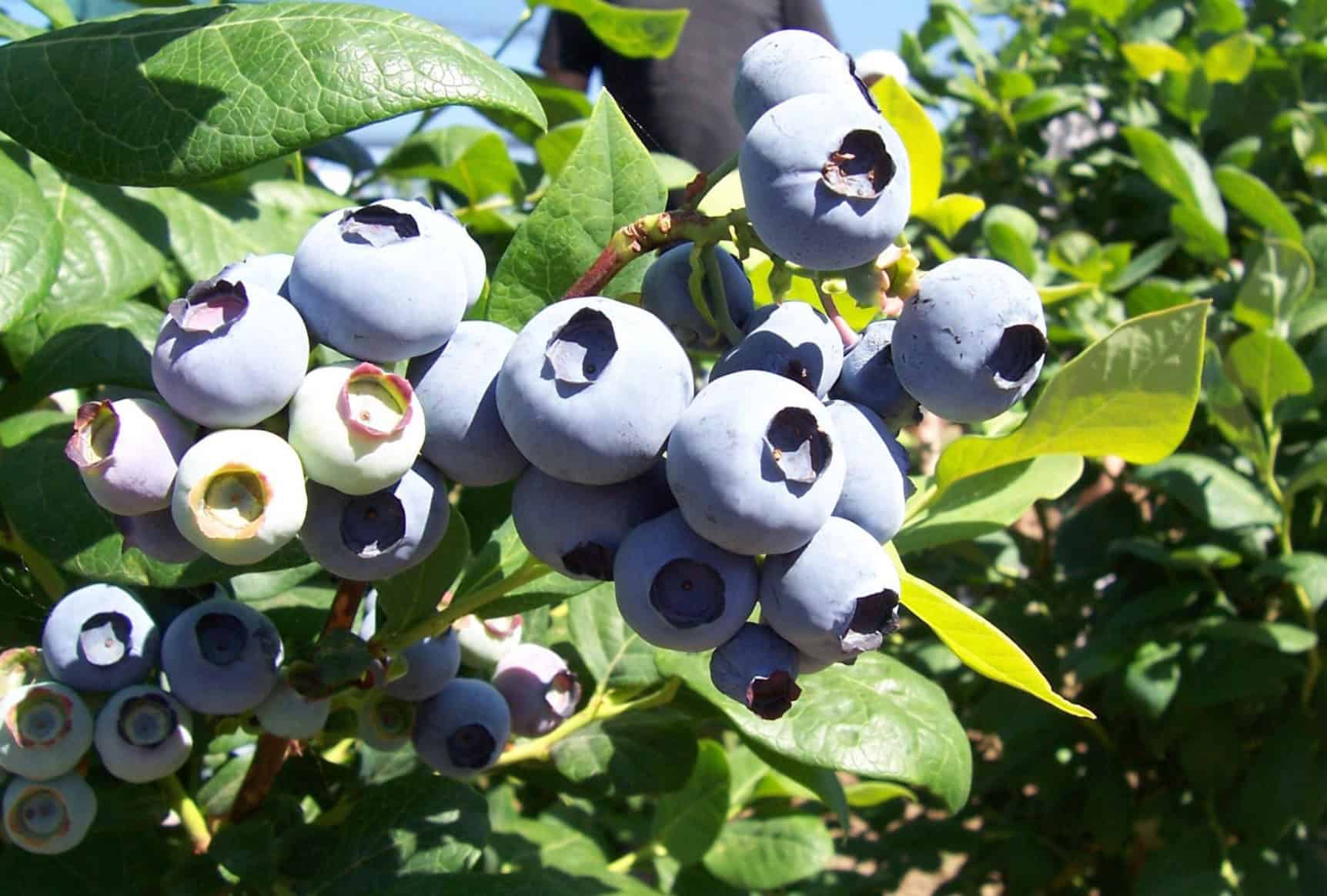
Northern Highbush “Duke”
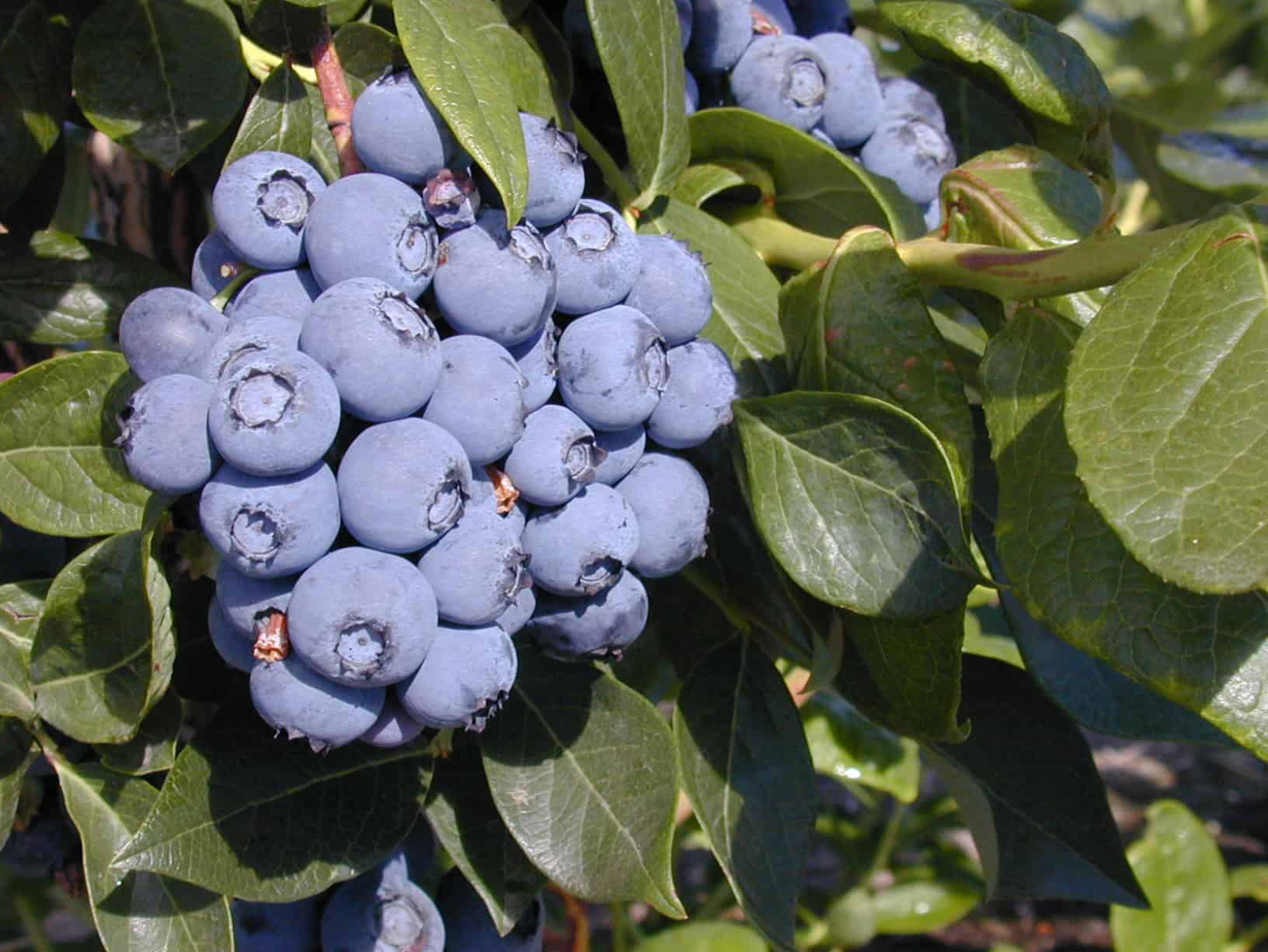
blueberries
© Photo Chad E. Finn, OSU PNW Extension Publication

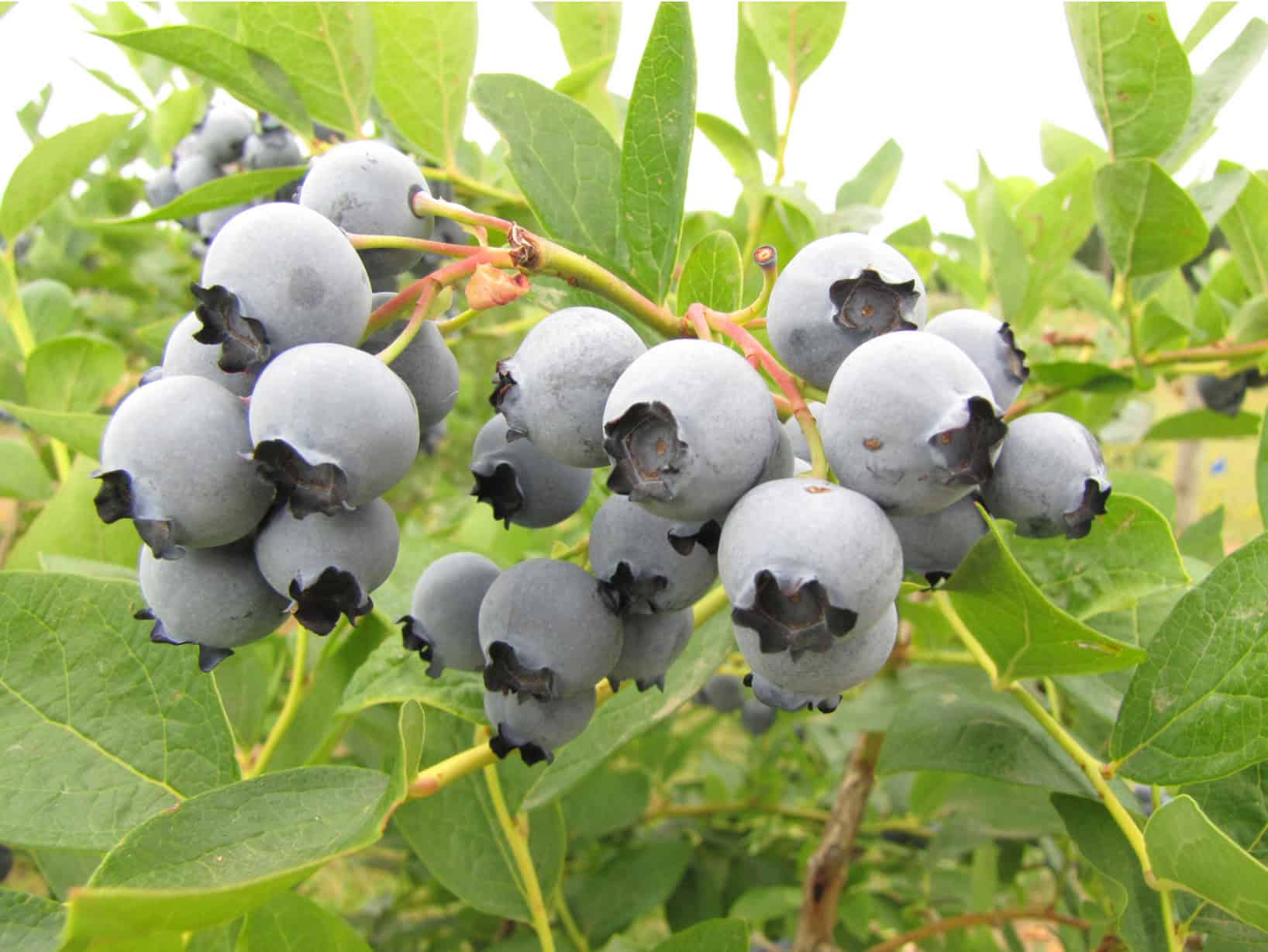
Northern Highbush “Draper”

draper blueberries on branch
© Photo Chad E. Finn, OSU PNW Extension Publication

Northern Highbush “Bluejay”

highland blueberry on branch
© Photo Chad E. Finn, OSU PNW Extension Publication

Start by selecting a location and testing soil acidity

Home gardeners can start by selecting the right location and soil for blueberry bushes. Blueberries require acidic soil with a pH of 4.2 to 5.5, similar to rhododendrons and azaleas, according to a 2025 presentation to Skagit County Master Gardeners trainees by Lisa Wasko DeVetter, associate professor of small fruit horticulture at Washington State University’s NWREC in Mount Vernon. Soil can be lab tested for pH, and if needed, acidification can be enhanced. A publication by Oregon State University Extension titled “Acidifying Soil for Crop Production West of the Cascade Mountains” provides a good resource on evaluating and enhancing soil acidity.

Because of the acidic soil needs of blueberries, home gardeners will need to plan ahead and prepare the space and soil before the arrival of the early spring planting season.

Blueberries can also be grown in containers and flourish in the full sun.

Plant selection, pollination, and care
Home gardeners should select two- to three-year-old plants (when shopping, ask at the nursery about plant age) and be on the lookout for those that are disease and heat-resistant “Legacy”, “Rubel”, and “Liberty”, have shown resistance to common diseases and rising summer temperatures in the NW Fruit Garden.

Plant blueberries from January to March, spacing three feet apart, in holes large enough to handle all of the shallow roots and allow three to four inches of soil to cover. Once established, blueberry plants are quite sturdy, with most producing fruit for 20 years.

While northern highbush blueberries are self-fertile, experts advise home gardeners to plant at least two different cultivars with overlapping bloom times in proximity to one another to benefit from cross-pollination and larger, earlier fruit.

All northern highbush blueberries are compatible with each other for cross-pollination.

Remove all flowers during the first year or two after planting to prevent fruit from setting and to give plants time to mature and enhance future yield.

Fertilize annually with a focus on nitrogen. For more information, see Oregon State University Extension publication EM 8857 titled “Nutrient Management for Blueberries in Oregon.” 

Blueberries require regular, supplemental watering from May to August and annual mulching with untreated wood chips.

Interested in Becoming a Master Gardener?

Application period is now open through August 15, 2025.

WSU has recently launched a new training platform called Washington Green School, designed to provide comprehensive research-based horticulture and environmental stewardship education. The Washington Green School offers two distinct tracks:

  • Washington Gardener Certificate Track
    This option is ideal for individuals seeking to enhance their gardening skills without the commitment of volunteering. This self-paced, online-only course provides a certificate upon successful completion.
  • Extension Master Gardener Volunteer Track
    This track is for those interested in becoming certified WSU Extension Master Gardener volunteers and includes the Green School online coursework, in-person, local volunteer training, and a commitment to volunteer service hours.

For more information, go to https://skagitmg.org/home/green-school/

To apply for the Skagit County WSU Extension Master Gardener Program, go to https://extension.wsu.edu/skagit/mg/apply/


Prune each year in winter or early spring to eliminate any dead or weak shoots and select two to three new canes to retain for the next season. Prune carefully to retain the desired shoots, creating a vase shape that opens up the middle of the plant to provide air and light. Half-high cultivars do not need to be pruned as severely or as regularly as highbush types.

Healthy, established blueberry plants can yield more than one gallon of fruit per plant.

Blueberry plants can decline over time and should be replaced when they stop sending up new shoots during the growing season.

Pests and common diseases
A variety of pests and diseases can impact blueberry bushes and fruit.

Birds enjoy feasting on blueberries. To protect the fruit harvest from birds, home gardeners may want to cover plants with fine netting mounted on a frame and anchored to the ground from mid-June through harvest completion in August. If the bushes are growing for landscape purposes, let the birds have a summer snack.

Spotted wing drosophila, aphids, scale insects, root weevils, inchworms, and fruit worms can damage blueberry plants and fruit. To prevent or manage such infestations, refer to WSU’s publication “Growing Small Fruits in the Garden.”

In northwest Washington, blueberries are impacted primarily by two diseases: mummy berry and botrytis blight or gray mold.
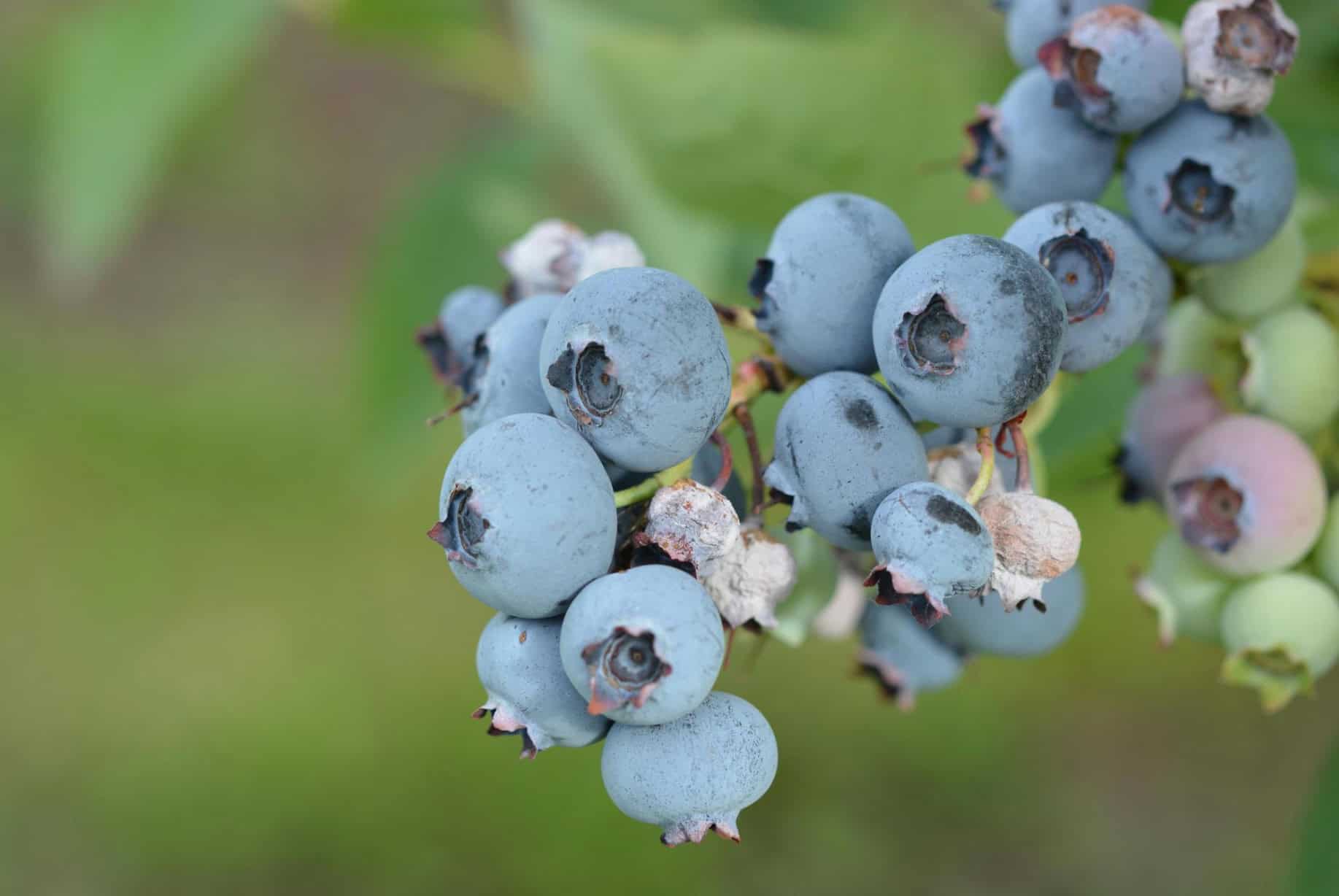
blueberries with shrunken mummy berry disease
Mummy berry © Photo Jade Florence, Oregon State University
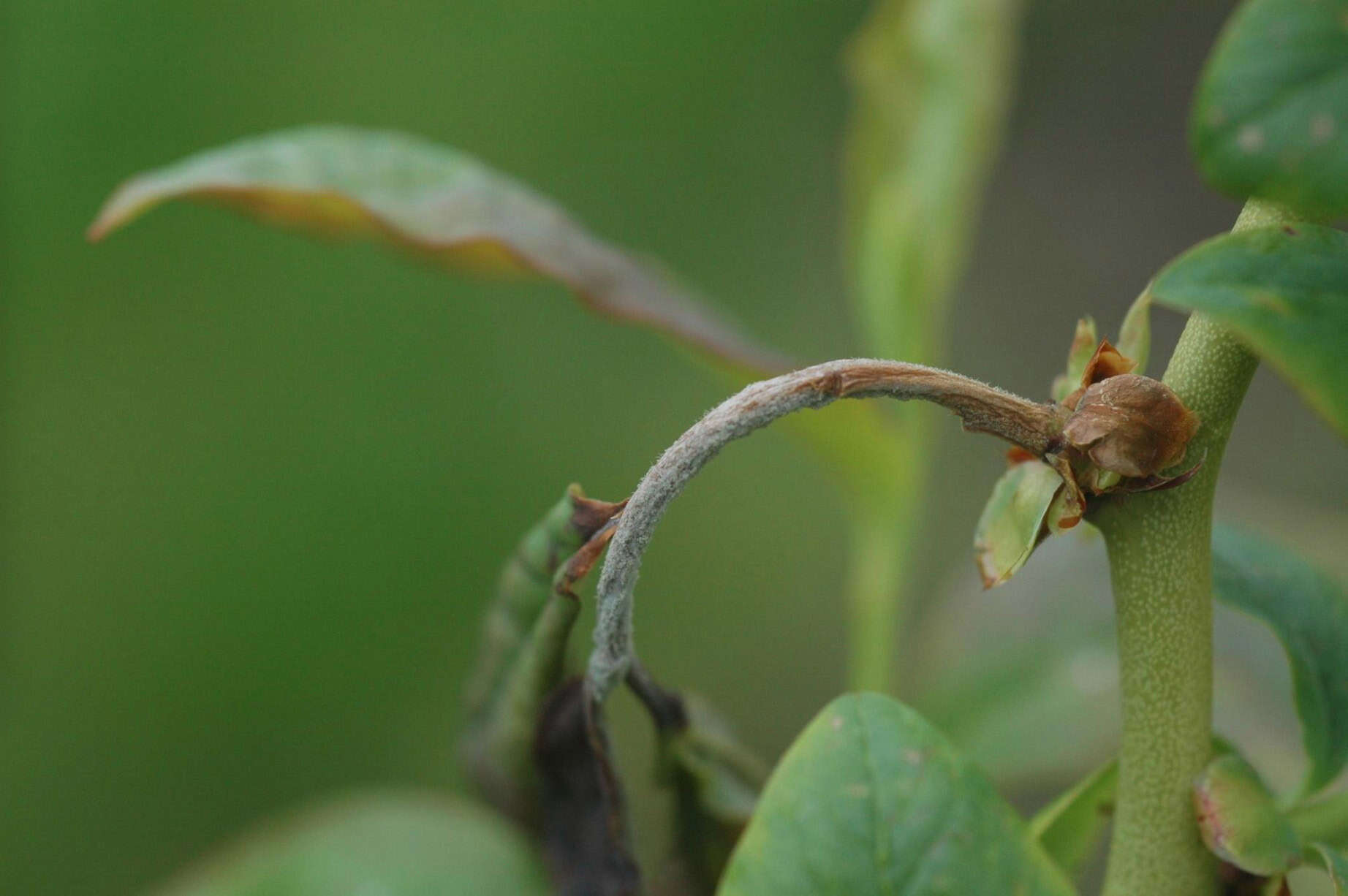
dead branch of blueberry caused by mummy berry
Mummy berry infection is identified by a spore mat covering the leaf stem. © Photo Jay W. Pscheidt Oregon State University

Mummy berry is easily identified by the home gardener in the mid- to late- stages as the mature mummified fruit appears gray, shriveled, hard, and inedible. The disease is caused by a fungus that infects young flowers and vegetative buds in spring. About three weeks after primary infection, a brownish-gray mass of spores develops on blighted flower stalks and leaves that are spread by wind, rain, and honeybees (pollinators) to healthy flowers.

To manage the disease, the home gardener must remove the mummified fruit from the plant and lift it off the ground, add about two inches of mulch around the plants, and regularly disturb the soil during the spring. Healthy fruit can be harvested and used. At season’s end, clean the area to prevent infected berries from overwintering.

Blueberries, strawberries, and raspberries, especially on the west side of the Cascades, are affected by botrytis blight and gray mold. The cool and wet weather in western Washington is conducive to the development of this disease. Pruning creates airflow in the plant canopy, and reduced moisture on the foliage or fruit can help slow down the fungal growth.
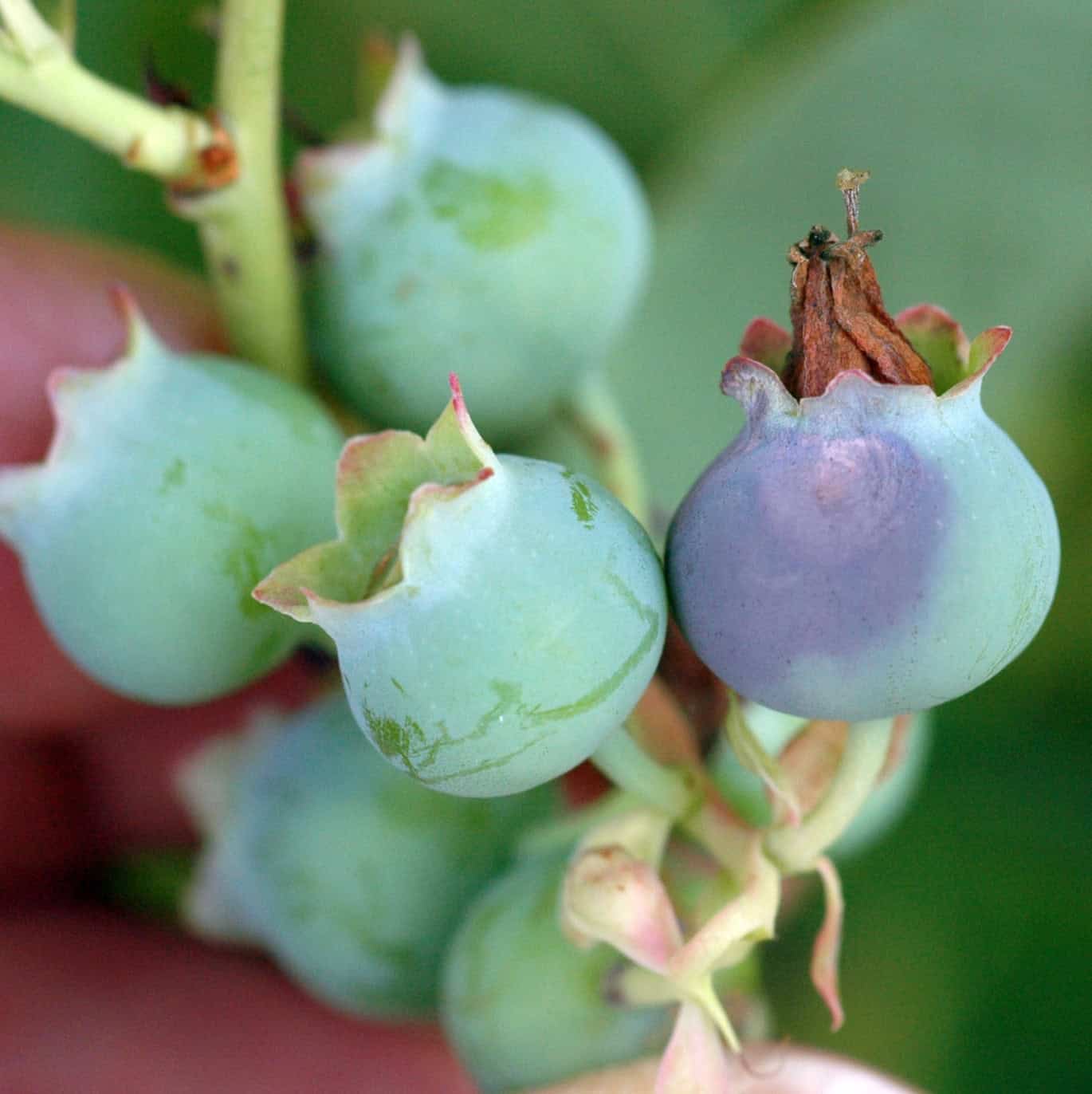
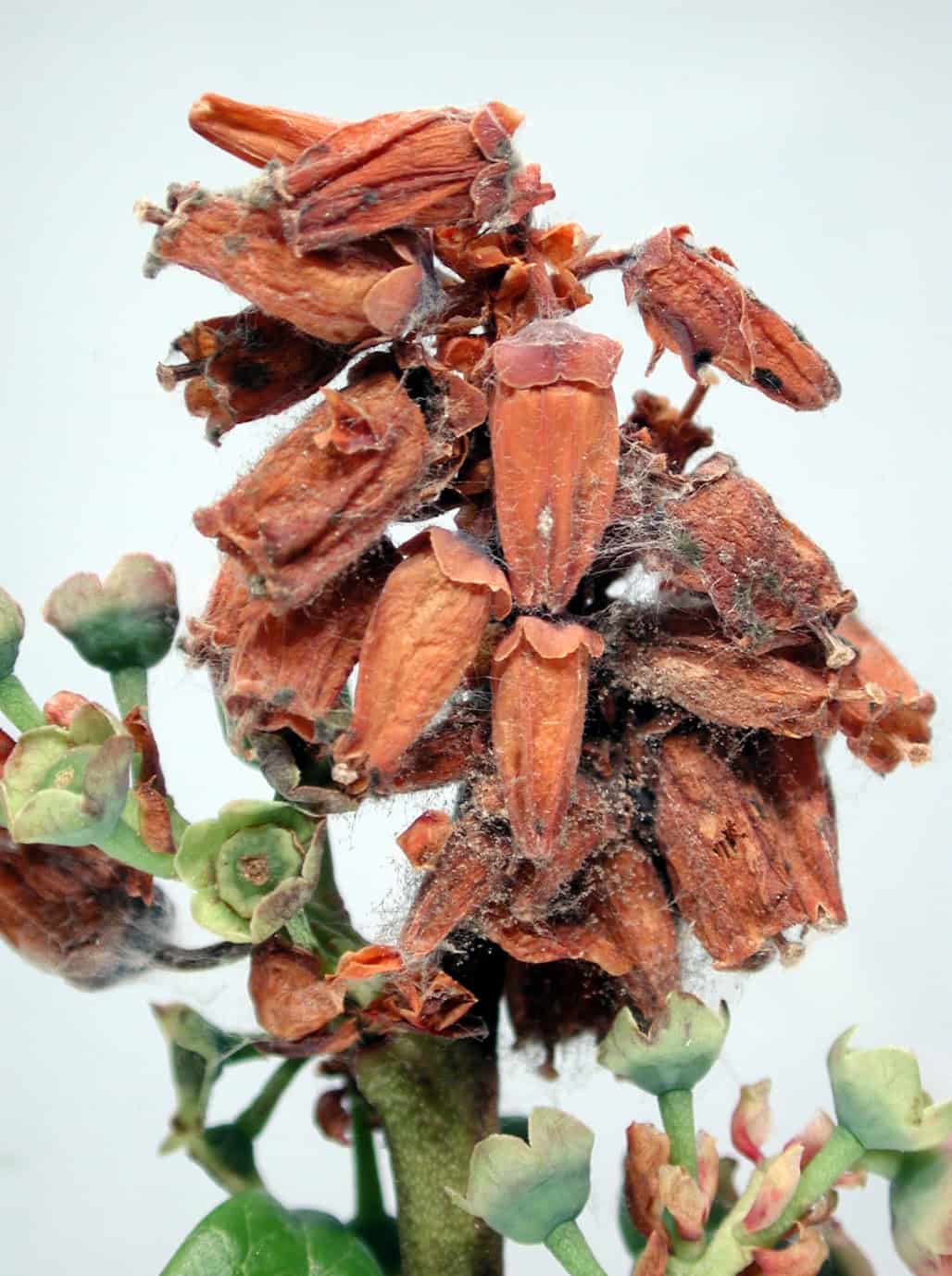
blueberries with botrytis
© Photo: Jay W. Pscheidt, 2010. PNW Pest Management Handbook
blueberry plant with brown husks of disease
Botrytis rot of green fruit. Here the floral tissue is seen still attached to the berry. © Photo: Jay W. Pscheidt. PNW Pest Management Handbook

REFERENCES AND RESOURCES:

Brun, C. A., DeVetter, L., and Benedicts, C. (2016) Growing Small Fruits in the Home Garden. Washington State University Extension Home Garden Series. Publication #EM103E

Finn, C., Strik, B., and Moore, P. (2024) Blueberry Cultivars for the Pacific Northwest. Oregon State University Extension Service. PNW #656

Hart, J., Strik, B., White, L., and Yang, W. (2020) Nutrient Management for Blueberries in Oregon. Oregon State University Extension Service. EM 8918. 

Horneck, D., Hart, J. Stevens, R., Petrie, S., and Altland, J. (2004) Acidifying Soil for Crop Production West of the Cascade Mountains (Western Oregon and Washington). Oregon State University Extension Service. EM 8857. 

Pscheidt, J.W., and Ocamb, C.M. (2025a). Blueberry (Vaccinium corymbosum)-Mummy Berry.  Pacific Northwest Plant Disease Management Handbook. Oregon State University. 

Pscheidt, J.W., and Ocamb, C.M. (2025b). Blueberry (Vaccinium corymbosum)-Botrytis blight. Pacific Northwest Plant Disease Management Handbook. Oregon State University.

Washington State University Northwestern Washington Research and Extension Center. (2025) Berry and Potato Pathology.

Washington State University Skagit County Extension Skagit County Agricultural Statistics. (2024) Crop Acreage and Yield Report.

Yan, L. (2023) Blueberries and Health. USDA Agricultural Research Service.

ABOUT THE AUTHOR:

Kari Ranten is a retired journalist and health care communicator who became a certified Skagit County WSU Extension Master Gardener in 2024. 


Questions about home gardening or becoming a master gardener may be directed to Skagit County WSU Extension Office, 11768 Westar Lane, Suite A, Burlington, WA 98233; by phone: 360-428-4270; or via the Skagit County WSU Extension Master Gardener website.

Washington State University Extension helps people develop leadership skills and use research-based knowledge to improve economic status and quality of life. Cooperating agencies: Washington State University, US Department of Agriculture, and Skagit County. Extension programs and policies are available to all without discrimination. To request disability accommodations contact us at least ten days in advance.

roses blooming in Discovery Garden

Garden Open House and Ask a Master Gardener Day:

Eight acres, three gardens, infinite inspiration

Open House to Showcase Master Gardeners, Native Plant Society, and NW Fruit

May 1, 2025

Subscribe to the Blog >


By Kari Ranten, Skagit County WSU Extension Master Gardener

Kari Ranten

Want to know about gardening – from roses to vegetables? Want to learn more about including native plants in your landscape? Ever wonder how to grow, graft, and prune fruit trees? Learn about all of this and more at the annual Garden Open House on Saturday, June 28, 2025, in Mount Vernon.

Eight acres of gardens showcase amazing trees and native plants at the event slated for 10 a.m. to 2 p.m. at 16602 State Route 536 (Memorial Highway), just west of the Washington State University Northwestern Washington Research and Extension Center.

The event, sponsored by the Skagit County WSU Extension Master Gardener Program, takes place at gardens maintained by volunteers representing the Master Gardener Program, NW Fruit, and the Salal Chapter of the Washington Native Plant Society. In addition, several partner organizations will present interactive displays and information on clean water, noxious weeds, maintaining healthy landscapes, and promoting pollinators, birds, and other wildlife.

This annual event offers home gardeners in Northwest Washington the opportunity to experience a wide range of gardening skills, view hundreds of plants and trees, and learn ways to respect the environment. Master gardeners and many partners enjoy this opportunity to share the gardens and educate our neighbors. And it’s a great, free summer event for the whole family.

graphic showing three gardens in open house

Join Us for a Three Garden Open House

Saturday, June 28, 2025
10 am – 2 pm
Discovery Garden
16602 State Route 536 (Memorial Hwy.)
Mount Vernon, WA 98273
Fun Activities for Kids  ~  Plant Sale
Water Conservation Experts  ~  Noxious Weed Information
30+ Garden Rooms  ~  Plant Clinic and Gardening Help
Native Plants  ~  Pollinators
Talk to Fruit Tree Experts

The open house is a great venue to talk about the mission of the Master Gardener Program and to provide evidence-based scientific information for the home gardener. It is also a wonderful event and very rewarding to meet and exchange ideas with local gardeners.

The open house will feature three gardens:

The Discovery Garden

people at open house in discovery garden
The open house is a great venue to talk about the Master Gardener Program and to meet and exchange ideas with local gardeners. Credit: © Skagit County Master Gardeners

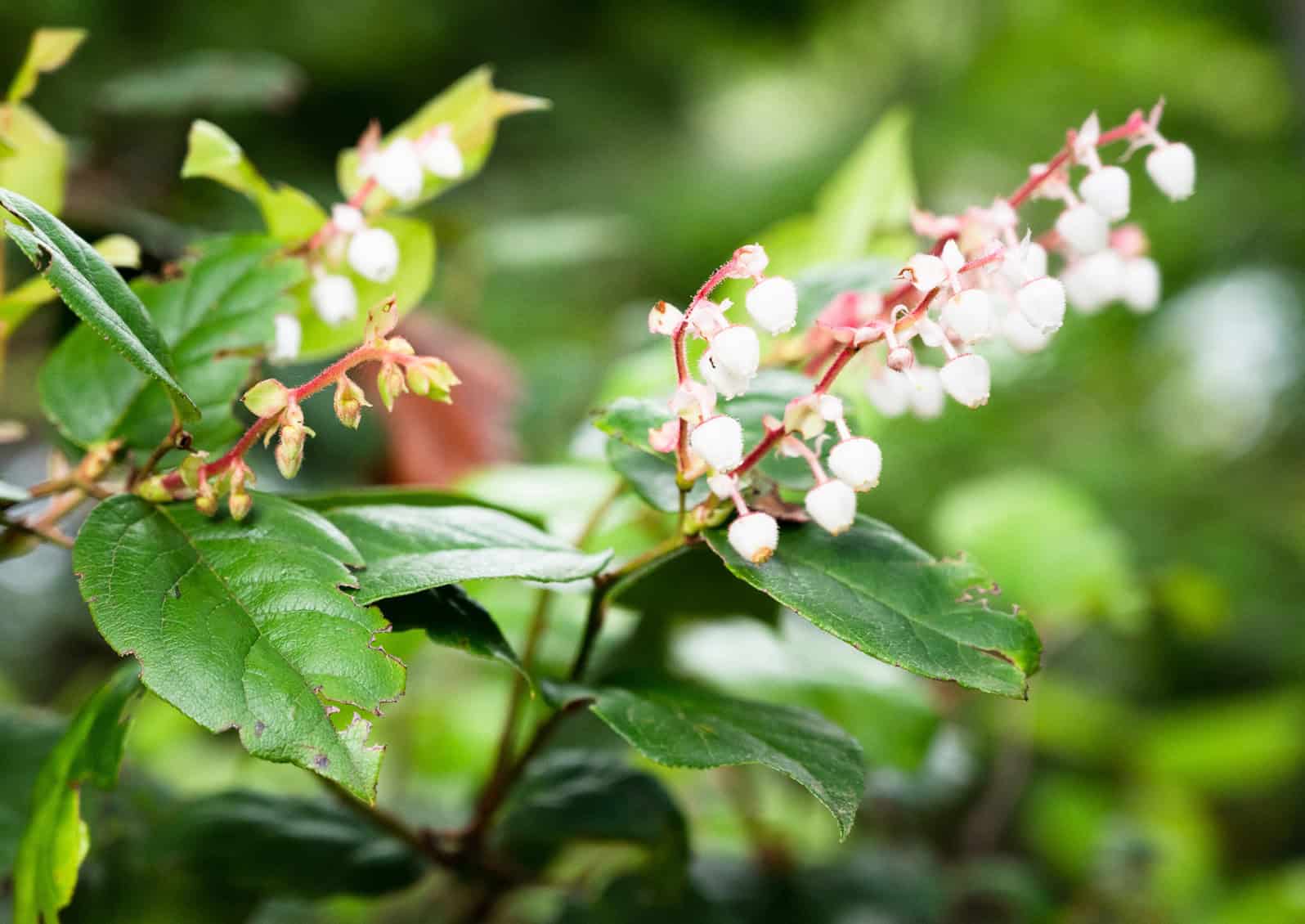
The Salal Garden

white flowers on blooming salal
A shaded trail through the half-acre Salal Garden leads visitors into a natural setting featuring dogwood, salal, cascara, vine maple, ferns, trillium and more. Credit: © Salal Chapter Northwest Chapter of Washington Native Plant Society.

The NW Fruit Garden

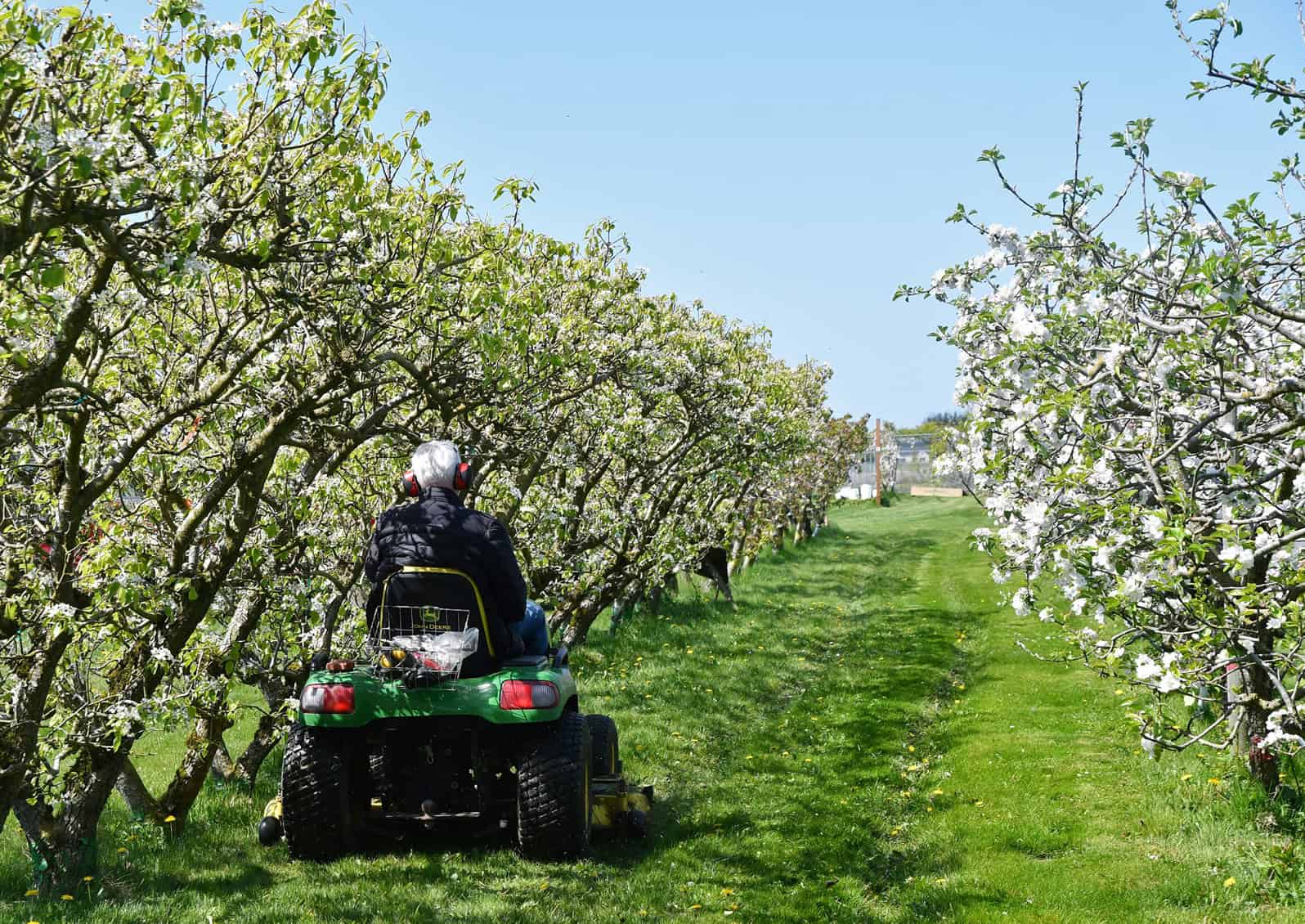
mowing near blooming fruit trees
The NW Fruit Garden encompasses six acres of fruit trees, berry bushes and other fruit-bearing plants, along with nut trees. Altogether, the garden features 606 plants – from peach and persimmon to apples and Asian pears. Credit: Used with permission © Scott Terrell

Discovery Garden:
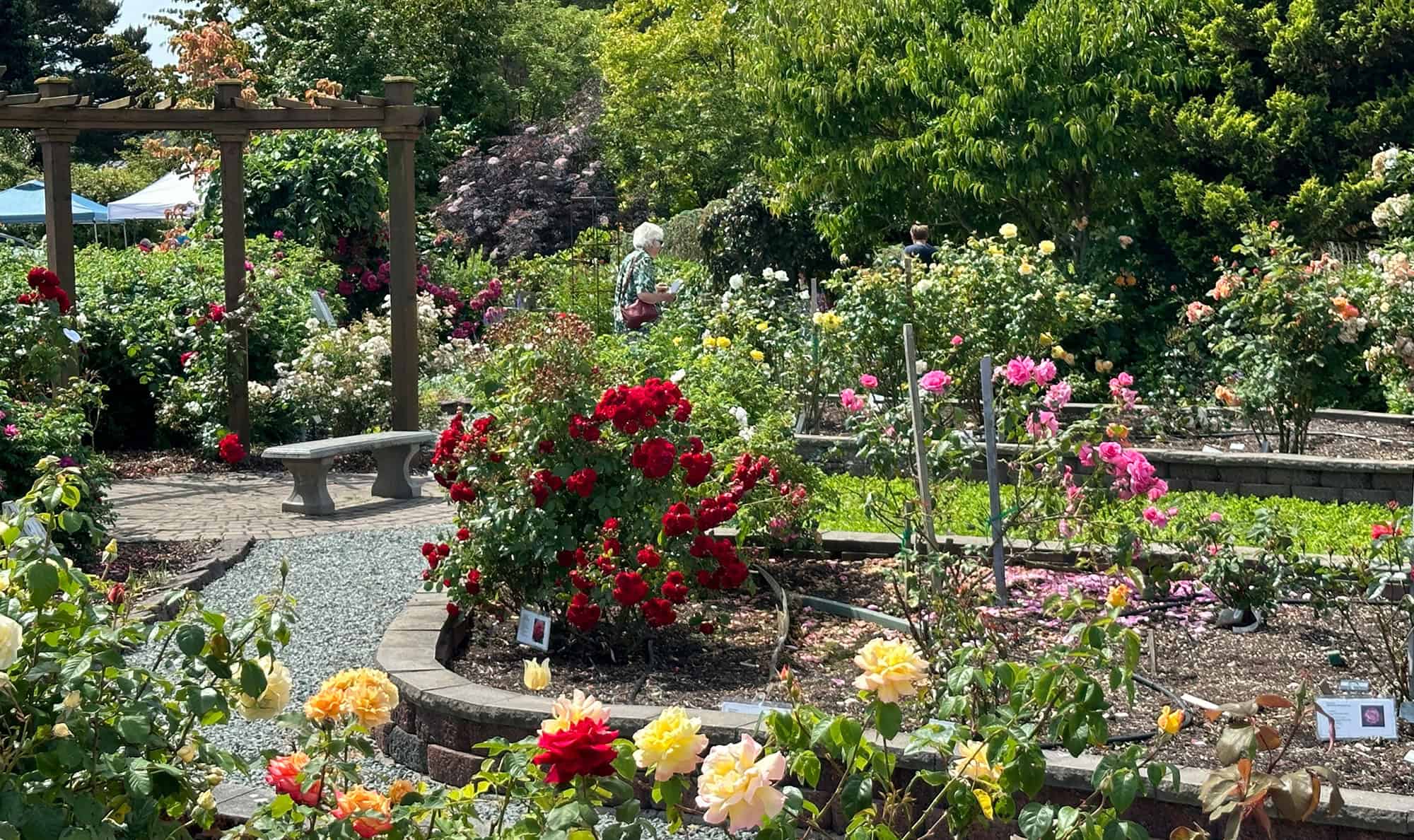
This is truly a hidden gem in Skagit County that merits discovery! Nearly half of the guests at the 2024 open house said it was their very first visit – including those who live locally! June is a great time to experience the garden where visitors will find beautiful blooming colors, including many perennials and dozens of rose varieties, all selected to thrive in the Pacific Northwest.

This amazing 1.5-acre oasis is maintained by the volunteers of the Skagit County WSU Extension Master Gardener Program. The Discovery Garden features 30 garden “rooms” ranging from herbs and heathers to roses and vegetables. The garden paths are ADA-accessible paths and include the Enabling Garden to illustrate ways to adapt the joy of gardening for those with mobility issues. Master gardeners will be on site to answer questions, demonstrate best practices, and inspire home gardeners.

People walking in beautiful garden
The Discovery Garden is 1.5-acre oasis is maintained by the volunteers of the Skagit County WSU Extension Master Gardener Program and demonstrates best practices and inspire home gardeners. Credit: © Skagit County Master Gardeners
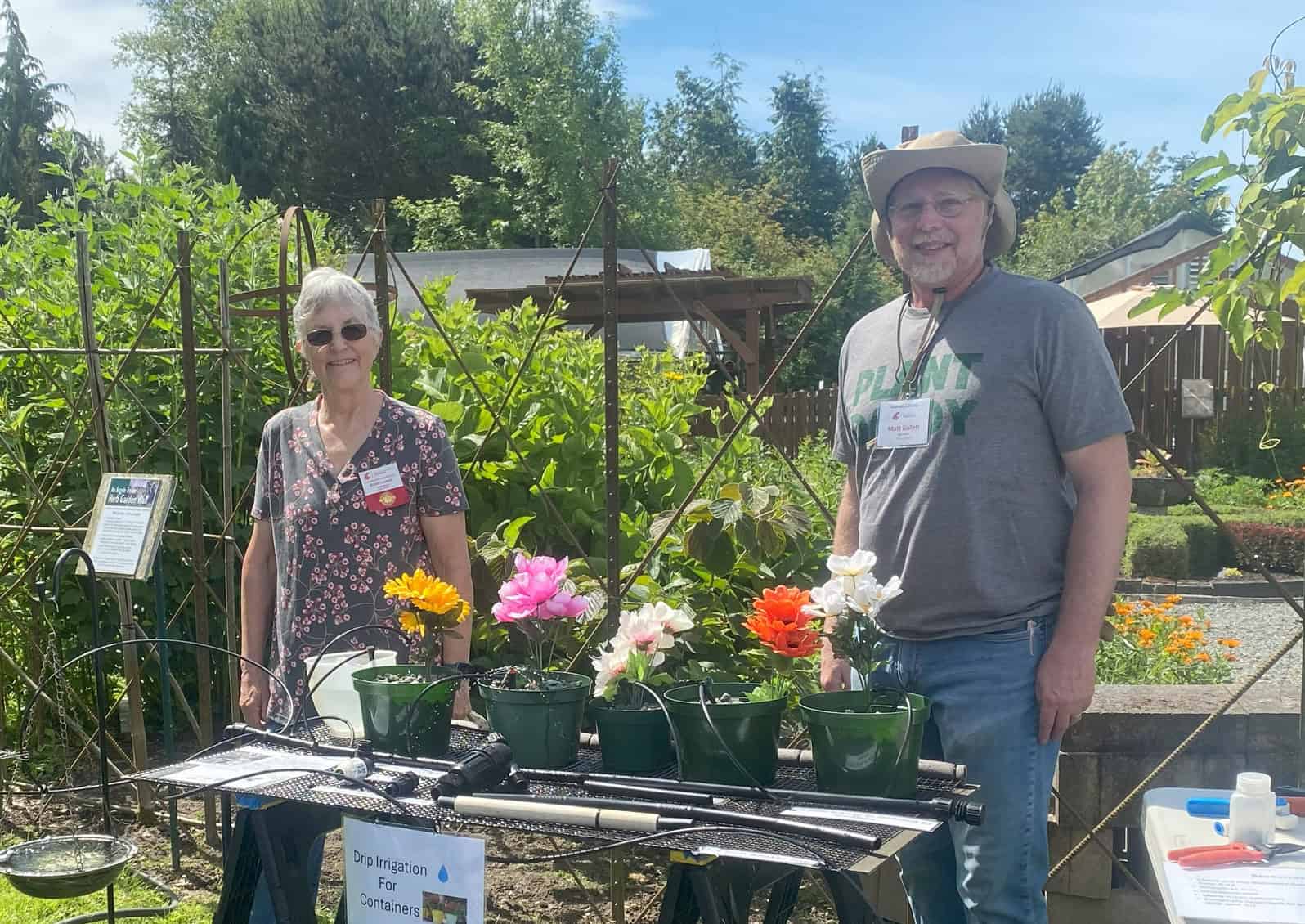
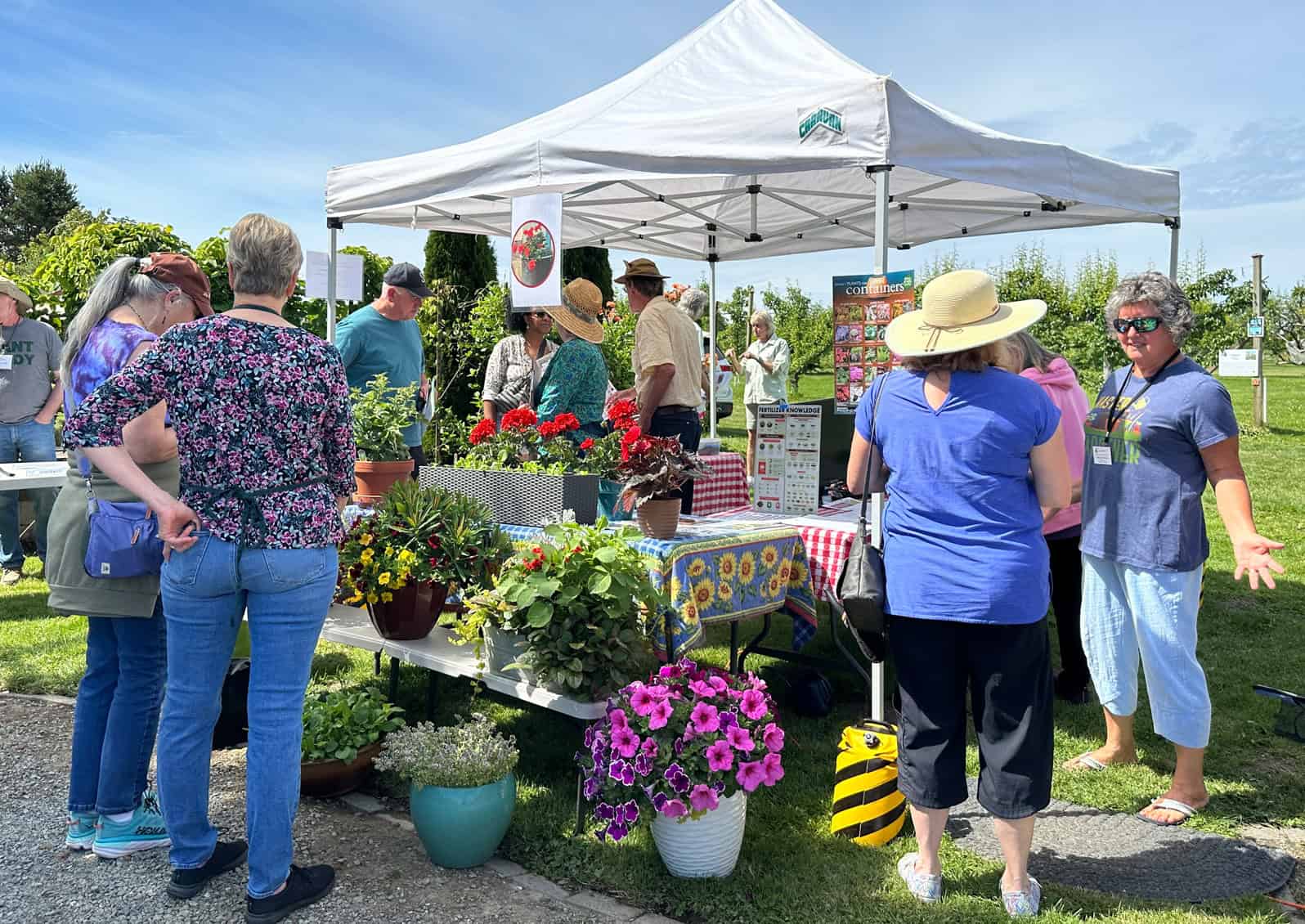
people at display table
The Garden Open House will feature displays about container gardening, drip irrigation systems, clean water practices, and dealing with noxious weeds. Credit: Credit: © Skagit County Master Gardeners

Salal Native Plant Garden:
Adjacent to the Discovery Garden, this half-acre oasis of native plants is maintained by volunteers of the Washington Native Plant Society’s Salal Chapter to demonstrate how native plants can be incorporated into the home landscape. A shaded trail leads visitors into a natural setting featuring dogwood, salal, cascara, vine maple, ferns, trillium, and more. Volunteers, representing north Snohomish, Skagit, and Island counties, will be on hand to guide garden tours and answer questions. For information, go to https://www.wnps.org/salal.
NW Fruit Garden:
Adjacent to the Discovery Garden, the NW Fruit Garden encompasses six acres of fruit trees, berry bushes, and other fruit-bearing plants, along with nut trees. Altogether, the garden features 606 plants – from peach and persimmon to apples and Asian pears. The garden features a growing collection of larger antique apples, many of which were grown during the 1960s and 70s. The mission of the NW Fruit Garden is “to advance fruit horticultural practices for the unique Western Washington maritime climate through advocacy, research, education, and demonstration for the benefit of the general public and the small farmer.” Volunteers will be on hand to answer questions, offer tours, and provide demonstrations.

A popular feature and photo op at the NW Fruit Garden is the welcome espalier – using grafted and supported fruit tree limbs to spell out the word WELCOME. The welcome and the entire tree fruit garden were designed in the 1990s by the late Kristan Johnson, https://nwfruit.org/fruit-garden-designer/ a landscape architect.

Booths and more features of the open house:

Get your “passport” and enjoy the open house:
Upon arrival at the open house, guests will receive a “passport” to track their visits to each of the activities offered at the event. Complete the passport and take home a prize!
Check out the Children’s Garden:
A wonderland of activities for children of all ages awaits visitors to the Children’s Garden with fun surprises and interactive features. During the open house, children can enjoy free rock painting and bubble blowing within the whimsical garden space.
Container gardening display:
Using pots and containers for gardening – from flowers to vegetables – is a popular method in the northwest. Containers can be useful options for gardeners with limited space or accessibility issues. The demonstration will feature containers for growing food as well as decorative elements, show how containers can allow hardy indoor plants to spend months outdoors, and provide opportunities for children to have their own mini gardens.

Nearly anything can provide a home to successfully grow plants, and volunteers will show examples to stimulate visitors’ creativity. The educational display will also feature information on soil types and amendments, as well as what contents to look for in commercial soil products.

Interested in Becoming a Master Gardener?

Application period is now open through August 15, 2025.

Stop by the WSU Extension booth to learn more about the new Washington Green School, the newly launched training platform designed to provide comprehensive research-based horticulture and environmental stewardship education. The Washington Green School offers two distinct tracks:

  • Washington Gardener Certificate Track
    This option is ideal for individuals seeking to enhance their gardening skills without the commitment of volunteering. This self-paced, online-only course provides a certificate upon successful completion.
  • Extension Master Gardener Volunteer Track
    This track is for those interested in becoming certified WSU Extension Master Gardener volunteers and includes the Green School online coursework, in-person, local volunteer training, and a commitment to volunteer service hours.

For more information, go to https://skagitmg.org/home/green-school/

To apply for the Skagit County WSU Extension Master Gardener Program, go to https://extension.wsu.edu/skagit/mg/apply/


Master Gardener Plant Clinic:
The plant clinic, located in the Pavilion structure at the center of the Discovery Garden, is a popular part of the annual open house and the Skagit County WSU Extension Master Gardeners Program’s year-round outreach to assist home gardeners in diagnosing plant problems. The variety of issues routinely brought to the clinics include identification of poison hemlock; treatment of rust on red raspberries; tent caterpillars; powdery mildew on grapes; how to mitigate damage by deer; and questions about soil testing. Guests may bring a plant sample and photos to the plant clinic to help the master gardeners identify the problem and provide advice.

The certified master gardeners provide science-based information to home gardeners about sound and sustainable gardening practices, including integrated pest management, efficient watering technologies, recycling garden waste, and cultural methods for preventing and treating plant disease.

Ask a Master Gardener Blog:
Master gardener volunteers who write, edit, and take photos for the twice monthly “Ask a Master Gardener” blog will staff a booth where guests can sign up to receive blog posts, pick up copies of popular articles, and offer suggestions for future articles. The blog features a wide range of articles written by Skagit County WSU Extension Master Gardeners on topics relevant to gardeners in the North Puget Sound area.
Plant Sale:
Master gardeners will offer a variety of perennial plants for sale at the open house, all propagated and nurtured over the past months. Ferns, figs, grapes, native trees and shrubs, epimedium, Douglas fir, and more will be available for sale.
Skagit County Noxious Weed Program:
Skagit County’s Noxious Weeds program surveys, treats, and supports landowners in treating invasive plants around the county. The program has a particular focus on knotweed, which often infests river and streambanks, and spartina, an invasive grass that grows in salt marshes.

County program staff will be on hand to show photos of and information on many of Skagit County’s most notorious and harmful noxious weeds. Staff will answer questions about what weeds may have infested visitors’ properties, offer suggestions for treating them, and provide informational materials to take home.

Skagit County Clean Water Program:
Skagit County’s Clean Water Program uses a variety of efforts to keep pollution out of local waters. The program team works to reduce stormwater pollution and monitors local waterways to spot bacterial pollution from dogs, failing septic systems, and farms. Their projects reduce dirty runoff into streams and work with the public to help protect water.

At the Garden Open House, Skagit County Clean Water staff will focus on how beautiful gardening and landscaping can go hand in hand with protecting our water. The booth will include a display and information on permeable pavement (paved surfaces that still allow rainwater to soak into the ground underneath). Educational materials will address how to garden without adding harmful chemicals and excess nutrients to local waters, as well as how planting native plants can create a habitat, protect water, and look amazing in the garden.

Skagit Conservation District
The Skagit Conservation District’s mission is to bring voluntary, incentive-based natural resource solutions to the citizens of Skagit County and beyond by providing technical, financial, and educational resources.
​The district works with landowners and farm operators to plan and implement conservation practices on private land. The district is a non-regulatory agency, which means that all practices implemented by landowners and farm operators who participate in its programs (cooperators) are voluntary.

The district’s booth will feature information on creating and maintaining healthy landscapes, rainscaping, and planting for pollinators, birds, and other wildlife.

For home gardeners who can’t make it to the open house, master gardeners have work sessions at the Discovery Garden from 9 a.m. to noon on Tuesdays through September, and visitors are welcome to stop by, ask questions, and learn some tips from the experts.

All three gardens are open year-round and are free to the public seven days a week from dawn to dusk. Visitors are invited to stop by throughout the year to view the seasonal changes, colors, and blooms. Signage in each garden identifies the plants, making for interesting and educational self-guided tours.

REFERENCES AND RESOURCES:

Kenny, E. (2007) Bob Norton, the king of apples, brings his passion for fruit to Vashon.

NW Fruit. (2025)

Skagit Conservation District. (2025)

Skagit County Clean Water Program. (2025)

Skagit County Master Gardener Foundation. (2025).

Skagit County Noxious Weed Program. (2025) 

Washington Native Plant Society Salal Chapter. (2025)

ABOUT THE AUTHOR:

Kari Ranten is a retired journalist and health care communicator who became a certified Skagit County WSU Extension Master Gardener in 2024. 


Questions about home gardening or becoming a master gardener may be directed to Skagit County WSU Extension Office, 11768 Westar Lane, Suite A, Burlington, WA 98233; by phone: 360-428-4270; or via the website: www.skagit.wsu.edu/mg

Washington State University Extension helps people develop leadership skills and use research-based knowledge to improve economic status and quality of life. Cooperating agencies: Washington State University, US Department of Agriculture, and Skagit County. Extension programs and policies are available to all without discrimination. To request disability accommodations contact us at least ten days in advance.